TGIF: The Great White Shark Song
Tags: Andy Brandy Casagrande IV, Great White, Music, sharkComment (1) | Date Posted: February 19, 2010 at 3:30 AM
Via Climate Shifts this morning I discovered this video which enamored me for two and a half minutes. You have to go there to get the skinny on the video though (you should be reading them anyways!), but the punchline is “The range of fish, sharks, rays, sea snakes and other animals sighted on BRUVS tapes has been remarkable – over 300 species to date, from 3cm leatherjackets to 3m hammerhead sharks.”
I’m back from a productive trip to Ireland to work with colleagues there and then a nice Christmas break with the family on the Mississippi River in Illinois. So regular posting will now resume!
I found this gem in my reader this morning courtesy of Boing Boing and subsequently wasted about 1.25 hrs of my morning looking at old Weekly World News covers, which are now available freely on Google Books. Here are a few of my favorite covers!
Click on each Weekly World News cover to embiggen!
Every time you see me that Hammer’s just so hype
I’m dope on the floor and I’m magic on the mic
Now why would I ever stop doing this
With others makin’ records that just don’t hit
I toured around the world from London to the Bay
It’s Hammer Go, Hammer MC Hammer, Yo Hammer
And the rest can go and play
There are two kinds of people. Those who admit they love and know the lyrics to You Can’t Touch This and those who won’t admit they do. There are also two kinds of sharks. Those that bring the hammer and those that don’t.
Hammerhead sharks possess an amazing horizontally expanded head, reaching widths of 50% in some species, referred to as cephalofoils (from the Latin cephalicus meaning head and foil from hydrofoil) However, the evolutionary processes that drove the amazing head shapes of hammerheads remained a puzzle.
The cephalofoil is thought to confer multiple advantages for the skark, turning sharks into supersharks. Researchers speculate that it could potentially provide greater swimming ability and maneuverability, enhanced ability to capture and eat prey, heightened electrosense, and superior olfactory abilities. As if sharp teeth and speed were not enough?

Photo from Wikimedia Commons and available through the Creative Commons Attribution 2.0 License.
New work by McComb and colleagues examines another hypothesis—enhanced sight. Increasing distance between the eyes may increase stereovision and depth perception. The team compared sharks with varying size cephalofoils, from hammerheads with a head shaped like a shovel to those with a prominent T-shape. By passing a weak light over each eye and recording the eye’s electrical activity, McComb and authors were able to measure the field of view for each shark.
Hammerhead possessed the largest visual fields from 176-182 degrees compared to pointy nosed sharks at 159-172 degrees. The team also found that scallop hammerheads possessed tremendous binocular overlap at 32 degrees with the widest hammerhead, the winghead shark, 48 degrees, nearly three times the overlap of common sharks. The cephalofoil also benefits hammerheads in one other way—rear vision. Common sharks can only look forward compared to the full 360 degree view of a hammerhead. Hammerheads also compensated for blind areas by moving the head back and forth left to right, i.e. yawing, which increased with the size of the cephalofoil. This provides the hammerheads with a greater viewable space and more spatial information.

School of scalloped hammerheads (Sphyrna lewini) in the Galapagos. Source: Anthony Patterson. Available from Wikimedia Commons and available Creative Commons Attribution 2.0 License.
Thus the Hammer is just so hype because of increased sight…not dopeness on the dancefloor or the mic.

Variation in cephalofoils in hammerhead sharks. Figure from McComb et al. 2009
McComb, D., Tricas, T., & Kajiura, S. (2009). Enhanced visual fields in hammerhead sharks Journal of Experimental Biology, 212 (24), 4010-4018 DOI: 10.1242/jeb.032615
From National Geographic:
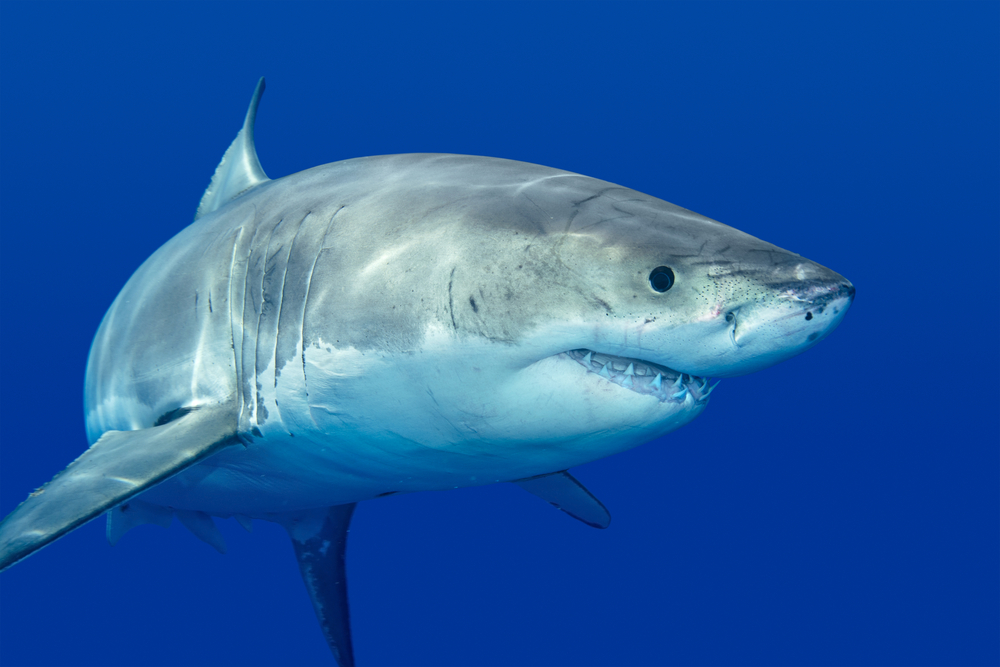
Filmmaker, Songwriter & Shark Junky – Andy Brandy Casagrande IV (ABC4) says: “IF I WAS A GREAT WHITE SHARK…I WOULDN’T BITE YOU”

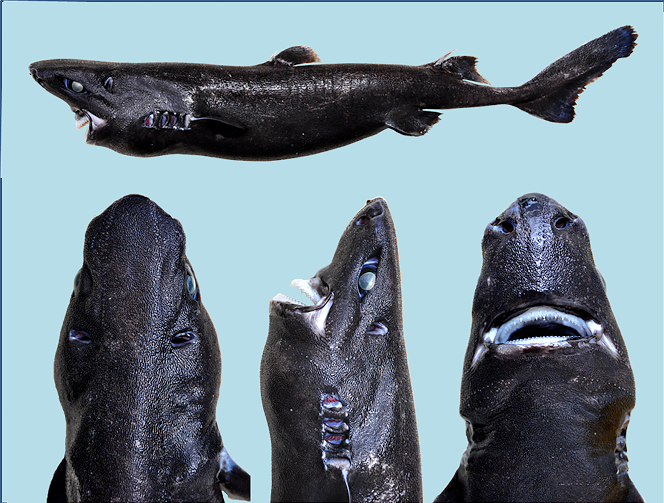
The Eastern Pacific black ghostshark (Hydrolagus melanophasma), a new species from California and Baja California, not taunting other marine life with its retractable forehead genitalia. Credit: MBARI
Chimaeras are sharks much cooler cousins. They are not sharks, i.e. elasmobranchs, but rather a whole other subclass, Holocephali, that split from sharks nearly 400 mya. They are primarily deep water which only endears them to me more. Chimaeras differ from sharks in subtle and not so subtle ways.
Much different from their toothy cousins, male chimaeras have retractable sexual appendages on the forehead. So now that you have that picture in your head, consider there is now one more known species of Holocephali. The new species, the Eastern Pacific black ghostshark (Hydrolagus melanophasma, Greek for ‘water rabbit’ and ‘black ghost’), was described in the September issue of the international journal Zootaxa. The new species is from deep water off central California down to the Sea of Cortez. As one of the author’s of the paper states ‘They have this club on the top of their head with spikes. People think it’s used for mating. It’s like a little mace with little spikes and hooks and it fits into their forehead. It’s jointed and it comes out. We’re not sure if it is used to stimulate the female or hold the female closer.”
Retractable sexual organ on forehead…check
Big retractable sexual organ on forehead…check
Jointed big retractable sexual organ on forehead…check
Jointed big retractable sexual organ on forehead equipped with spike and hooks…check
It’s days like this that I really appreciate the diversity of life. Below the fold a nice video, with horrible music, of shallow water chimaera.
Update: Greg Mayer has reminded that the organ on top is not genitalia, i.e. involved with gamete transfer. It is a hypothesized reproductive organ thought to “to stimulate the female or hold the female closer.” Jerry has wonderful post with pictures of both the organ on the forehead as well as the claspers (actual genitalia)! So I mention this because in my exuberance for a creative title I used the term genitalia. I now corrected this.
Hmm… What be that in the shark’s mouth? I have my own ideas, but would LOVE to hear what you think in the comments!
Some of the language might be NSFW.

Dunkleosteus skull at the Cincinnati Museum of Natural History
Way before even your great-great-grandpappy was born and Ohio was ocean instead of cornfields, it was the “Age of the Fishes”. During this Devonian (400-360 million years ago), the placoderms, giant, shark-like, armored fishes, ruled the oceans. Among the largest and most fearsome of these were the arthrodires, the joint necks. The lovely pet above is Dunkleosteus at 25 feet in length. I think we are going to need more butter! Given all the weight of the armor, Dunkleosteus was probably a slow swimmer. But hey when you are that big and armored how fast do you need to be?

Illustration by Steveoc 86 and licensed under the Creative Commons Attribution 3.0 Unported
Instead of teeth, those bony plates you see above would shear past one another forming vicious cutting edges. In 2007 Anderson and Westneat, built a computer model based on this big boy’s bones and muscle attachements. The two authors determined that a large individual could rip apart its prey with a force of 8000lbs at the tip of the jaws and with more than 11000lbs at the back of the dental plates. The authors conclude that “This bite force capability is the greatest of all living or fossil fishes and is among the most powerful bites in animals.”

Illustration by Arthur Weasley and licensed under the Creative Commons Attribution 3.0 Unported
Anderson, P., & Westneat, M. (2007). Feeding mechanics and bite force modelling of the skull of Dunkleosteus terrelli, an ancient apex predator Biology Letters, 3 (1), 76-79 DOI: 10.1098/rsbl.2006.0569