Yeti Crab Roundup
Yeti Crab Roundup avatar

Back in 2005, three researchers described and named a very unusual crab from a hydrothermal vent in the Indian Ocean (paper here).  The scientists christened this crustacean Kiwa hirsuta from the name of the goddess of shellfish in Polynesian mythology and the Latin hirsutus meaning hairy. The later specifically referring some very hairy claws indeed. Thus . . . → Read More: Yeti Crab Roundup

Yeti Crab Roundup avatar

San Diego red tide eaten alive by single-celled predator
San Diego red tide eaten alive by single-celled predator avatar

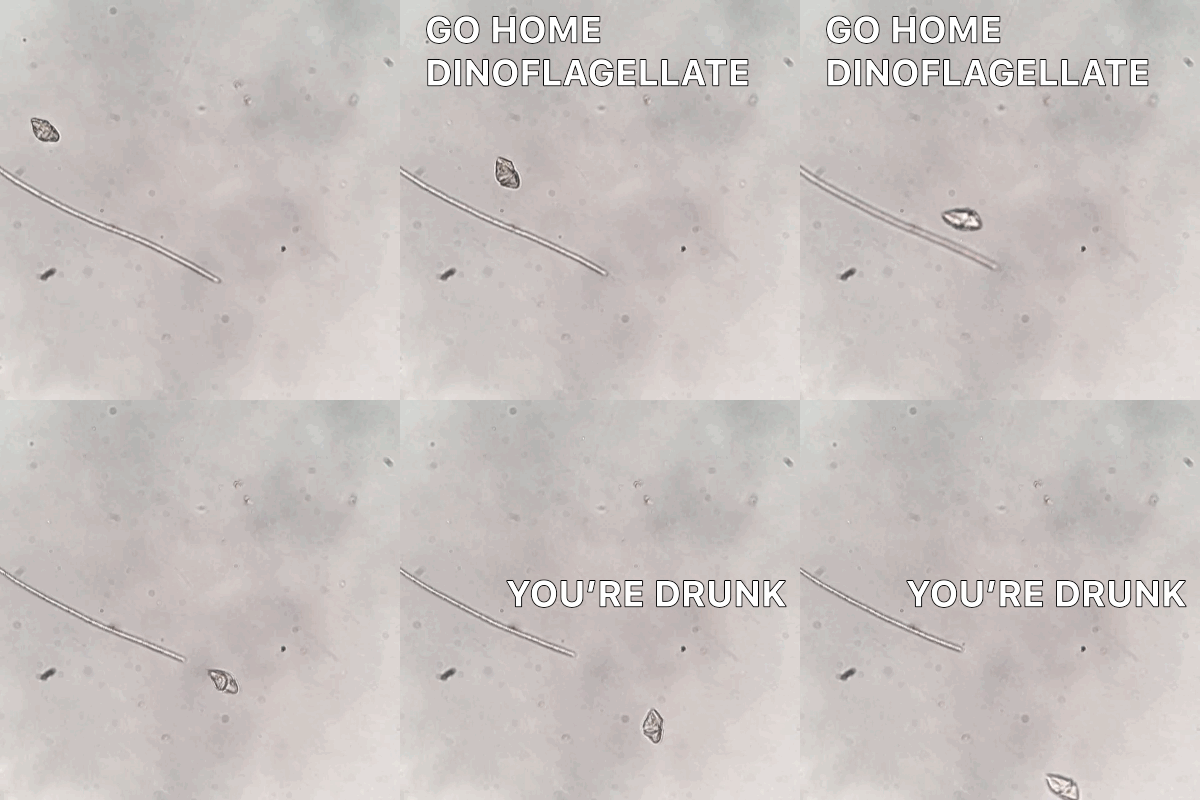
GET IN MAH BELLY! These huge predatory dinoflagellates have consumed smaller bioluminescent dinoflagellates. The red tide that has lit San Diego for several weeks is ending in a microscopic bloodbath. The above photo was taken by Linsey Sala, the manager of the Pelagic Invertebrates Collection at Scripps Institution of Oceanography. She writes: This image was . . . → Read More: San Diego red tide eaten alive by single-celled predator

San Diego red tide eaten alive by single-celled predator avatar

Blue whales in a red tide
Blue whales in a red tide avatar

Check out these gorgeous photos of blue whales going through the red tide! Eddie Kisfaludy took them with his iPhone from a small plane off La Jolla Shores, and they are published here with his permission. (Thanks, Eddie!) For more information on the current red tide – still going strong today – see our FAQ . . . → Read More: Blue whales in a red tide

Blue whales in a red tide avatar

The San Diego red tide: FAQ from Scripps professor Dr. Peter Franks
The San Diego red tide: FAQ from Scripps professor Dr. Peter Franks avatar

Dr. Peter Franks This is a guest post modified from two emails by professor of biological oceanography Peter Franks, reprinted here with his permission. Peter is a phytoplankton ecologist who studies how the physical processes in the ocean influence the growth and distribution patterns of phytoplankton, so he’s often the go-to guy on red tides. . . . → Read More: The San Diego red tide: FAQ from Scripps professor Dr. Peter Franks

The San Diego red tide: FAQ from Scripps professor Dr. Peter Franks avatar

Big text files can tell you how the ocean works
Big text files can tell you how the ocean works avatar

…because “High-throughput sequencing confers a deep view of seasonal community dynamics in pelagic marine environments”, however appropriate a title, seems far too dry and technical for a blog.  I mean, I want people to read my posts, right? Don’t be fooled by the title, though: I am going to give you some seriously elegant science . . . → Read More: Big text files can tell you how the ocean works

Big text files can tell you how the ocean works avatar

Marine Fungi are Totally Badass
Marine Fungi are Totally Badass avatar

That’s right, you heard me—there are mushrooms that live in the sea. OK, well technically a mushroom is a fruiting body of a fungus with a cap, stem and gills, but lets take some dramatic liberties and run with it.  A new draft manuscript recently necessitated that I review the literature on marine fungi – . . . → Read More: Marine Fungi are Totally Badass

Marine Fungi are Totally Badass avatar

Scientist in Residence: Beth Orcutt – “There is More to the Marine Subsurface than Sediments”
Scientist in Residence: Beth Orcutt – “There is More to the Marine Subsurface than Sediments” avatar

Beth is an U.S. postdoc scientist at the Center for Geomicrobiology in Denmark studying tiny microbes that live at the bottom of the ocean and their role in global processes. You can check out her website to learn more about her work. Greetings, lovers of the ocean depths!  I sheepishly pop my head back in . . . → Read More: Scientist in Residence: Beth Orcutt – “There is More to the Marine Subsurface than Sediments”

Scientist in Residence: Beth Orcutt – “There is More to the Marine Subsurface than Sediments” avatar

The Circle of Life (and how Jellyfish screw it up)
The Circle of Life (and how Jellyfish screw it up) avatar

Mufasa was right.  We’re all intertwined.  Whether we humans like to admit it or not, every action by a living organism on Earth has repercussions.  (And yes, you can lump in viruses and prions because I’m not getting into a philosophical debate about what constitutes ‘living’). Run, Harry! You don't want to catch Irukandji syndrome!!! . . . → Read More: The Circle of Life (and how Jellyfish screw it up)

The Circle of Life (and how Jellyfish screw it up) avatar

Scientist In Residence: Beth Orcutt Introduces Herself
Scientist In Residence: Beth Orcutt Introduces Herself avatar

Beth is an U.S. postdoc scientist at the Center for Geomicrobiology in Denmark studying tiny microbes that live at the bottom of the ocean and their role in global processes. You can check out her website to learn more about her work. Hello My Name is Beth Orcutt I’ve recently been spending an obsessive amount . . . → Read More: Scientist In Residence: Beth Orcutt Introduces Herself

Scientist In Residence: Beth Orcutt Introduces Herself avatar

Predicting Microbial Communities in the Deep-sea
Predicting Microbial Communities in the Deep-sea avatar

I recently reported on the awesomeness of high-throughput sequencing technologies, and commented on their huge potential for transforming the way biologists do business.  (Seriously, people, its going to be like the renaissance of 21st century science – you heard it here first!) As a follow up to my previous post, I wanted to highlight this . . . → Read More: Predicting Microbial Communities in the Deep-sea

Predicting Microbial Communities in the Deep-sea avatar