TGIF: Clever Octopus
Tags: OctopusComment (1) | Date Posted: February 19, 2010 at 11:36 AM
So here I was, just minding my own business under this rock-type thing and some freakish looking thing from Poseidon-knows-where started kicking up dirt and messing with me!
From NeptuneCanada’s youtube account:
“2-September-2009: As ROPOS touches down on the sediment next to the drillhead, an octopus watches warily from its lair at Ocean Drilling Platform 2016B (2660m below sea level). When ROPOS grasps an anemone-festooned rope, the startled animal shrinks into a pink ball. A short while later, as ROPOS prepares to fasten the rope to the drillhead, the octopus first lurks in the sediment, then flaps its web and flies off into the darkness.”
Looks like a Vulcanoctopus almost, I wonder if one our octopus experts out there can confirm… Thanks to Neptune Canada and other organizations out there for making these little moments available for us to see!
In December 2007, Portuguese police confiscated 9.4 tons of cocaine in a shipment of frozen octopus from Venezuela. “I suppose it’s possible that someone defrosted the animals, took out the cocaine, then threw their bodies overboard”
Even more disturbing is it is more likely a parasite, bacteria or virus.

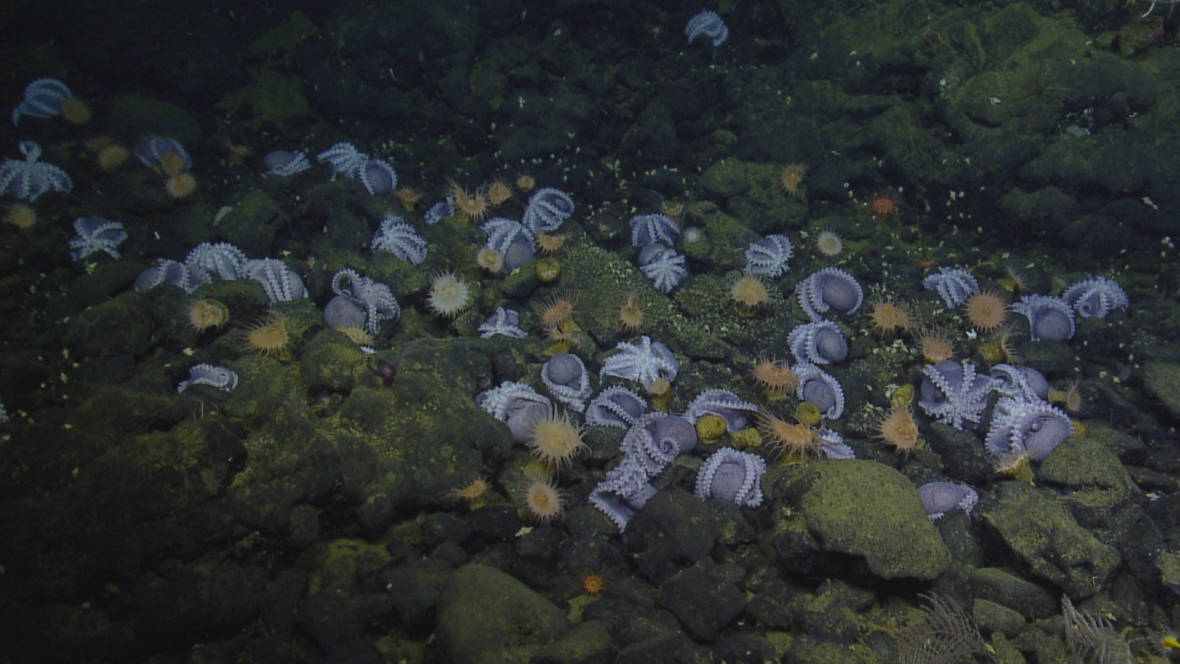
Greneledone boreopacifica....Are you my daddy? Image from wikimedia commons
Yo Ush, What up Kels
Wanna introduce you to this girl, think I really love this girl, Yeah?
Man she so fine, Straight up dawg?
She stand about 5’4” coke cola red bone, Damn
She drives a black Durango license plate say “Angel” tattoo on her ankle, Plus she’s making pay so she got a crib on Peachtree right on 17th street, And I call her “TT”
Wait a minute hold on dawg do she got a kid? Yep
…. she love some waffle house? Yep
Do she got a beauty mark on her left side of her mouth? Man?
Went to Georgia Tech? Yep
Works for TBS? Yep
Man, I can’t believe this chick… damn… mm
Tell me whats wrong dawg, what the hell you damning about, I’m your homie so just say what’s on your mind
Man I didn’t know that you were talking about her
So man you’re telling me you know her?
Do I know her? like a pastor knows his word
[Chorus]
We messing with the same girl same girl same girl
How could the love of my life, and my potential wife be the
Same girl, same girl, same girl
Man I can’t believe that we’ve been messing with the
Same girl, same girl, same girl
Thought she someone that I can trust
but she’s been doubling up with us
U K, man we’ve been messing with the same girl
New work by Voight and Feldheim finds evidence of multiple paternity in deep-sea octopods. The authors conduct a genetic analysis of 12 offspring in a single clutch. Who’s the baby’s daddy? In Graneledone boreopacifica the father could be one of two sires. The microsatellites don’t lie! But two sires of the same clutch of young is no record holder. In another cephalopods, the young were traced back to 5 daddies.
So how did this all happen? The male places his modified third arm, the hectocotylus, into an internal penis to acquire a sperm packet. He then presents the hectocotylus to the female and inserts it into her mantle cavity. The sperm packet itself is extremely hydrophyilic. When exposed to seawater, the sperm packet takes on water, evaginates, and releases a sperm bladder into the female. This sperm bladder must then detonate burst further into the female’s reproductive system.
So why so many daddies? Females that use sperm may have an advantage. The specifics of that advantage are a source for much conjecture. 1) Females get to replenish sperm supplies for later storage in a environment where mates may be scarce. 2) Females receive something other than sperm from males, like nutrients. 3) Females increase their likelihood of mating with a high quality male 4) Females are bet hedging against sterility of previous males. 5) Sperm competition allows the best sperm/male to win producing fitter young 6) Females increase the genetic variability in their offspring.
Voight, J., & Feldheim, K. (2009). Microsatellite inheritance and multiple paternity in the deep-sea octopus (Mollusca: Cephalopoda) Invertebrate Biology, 128 (1), 26-30 DOI: 10.1111/j.1744-7410.2008.00152.x
A report from Dr. M while he is at sea in the northeast Pacific. You can follow the expedition here.
Our first day in the water. The sea is calm and tremendously blue. Of course blue clear water means little primary production at the ocean’s surface. Through the 3.5km of transparent water column, the ROV Doc Ricketts, only its 77th time to descend to the seafloor, descended on lava flows dating to the early nineties. We start the dive on a very steep talus slope, dropping nearly one meter in depth for every horizontal meter. It is thought that the immense amount of lava rubble here was formed when the flow fell off the cliff face and simply rolled down the hill. We then proceeded to conduct biological transects, five in total, along two nearby volcanic cones covered in volcanic pillows. Some had burst open and we were able to see the remnants of their volcanic viscera scattered nearby.
In the nearly 15 years since this lava cooled, it appears few organisms have colonized. Randomly placed crinoids, small corals barely a tenth of their full height potential, a few asteroids (with one extremely rare to science), translucent enteropneusts and holothurians with only their well-filled guts visible, dot the blackened substrate. The highlight of the trip was a lone wolf predator, an octopus from the Opisthoteuthids, that was intrigued by this large heavily lighted robot in this otherwise jet black world. It examines us with a watchful eye as we do the same.
Hat tip to Cephalopod Tea Party!
Yes, this will be liveblogged as soon as it comes out in video. There is nothing wrong with a B-movie that knows it’s a B-movie. More importantly, there could possibly be nothing horrible about a movie with a GIANT OCTOPUS in it. It’s a known fact. (I am ignoring the fact that Lorenzo Lamas is a main character.)
Biomimetics is the field of study where animals provide the inspiration for engineering designs that can be exploited by us, quite literally “life mimicking”. It goes to show there is so much basic organismal biology that we don’t know and so much we can learn from observation and experimentation! Read the full article in New Scientist.
Mantle tip to Cephalopod Tea Party.