TGIF Surf Music Edition
This is the cutest thing evah. I have no idea what they are saying, but it sounds just adorable. The amigurumi duo even has a myspace page.
Hat tip to Boing Boing.
Comments (2) | Date Posted: February 12, 2010 at 8:51 AM
This is the cutest thing evah. I have no idea what they are saying, but it sounds just adorable. The amigurumi duo even has a myspace page.
Hat tip to Boing Boing.

Japanese researchers recently set a record with the deepest in-situ observation of a criniod. In the words of the authors,
Previous records of stalked crinoids from hadal depths (exceeding 6000 m) are extremely rare, and no in-situ information has been available. We show here that stalked crinoids live densely on rocky substrates at depths over 9000 m in the Izu-Ogasawara Trench off the eastern coast of Japan, evidenced by underwater photos and videos taken by a remotely operated vehicle.
Oji, T., Ogawa, Y., Hunter, A., & Kitazawa, K. (2009). Discovery of Dense Aggregations of Stalked Crinoids in Izu-Ogasawara Trench, Japan Zoological Science, 26 (6), 406-408 DOI: 10.2108/zsj.26.406
[googlemap lat="34.27083595165" lng="141.85546875" width="500px" height="500px" zoom="4" type="G_SATELLITE_MAP"]Izu-Ogasawara Trench[/googlemap]

A. manni, picture courtesy of C. Mah
Post from Chris Mah, purveyor of all echinoderm. Dr. Christopher Mah is a NSF Postdoctoral Fellow at the Smithsonian National Museum of Natural History. He obtained his Ph.D. from the University of Illinois and conducts reasearch on the biodiversity, biogeography, evolution, and ecology of Asteroidea. Despite his short careeer, his has published over 15 publications on these subjects including several new species descriptions.
Because Craig asked so nice, here is a special Echinoblog in honor of SEX WEEK at Deep-Sea News. (Info for this blog from Tominaga et al., 2004, Biol. Bull 206: 25)
I thought it would be fun to write about the oh-so rare occurrence of sexually dimorphic brittle stars? What does that mean? Males and females look different. A pretty fundamental difference among humans (and many vertebrates)-but among most animals-only THEY seem to really know for certain!

A. manni oral view, picture courtesy of C. Mah
Nearly ALL species of echinoderms have essentially indistinguishable genders until you can look at their gametes or reproductive tissues. So, having a species with males and females that are clearly different is unusual.
In this case..our feature critter is a species of ophiuroid or brittle star, Ophiodaphne formata, which is found in the tropical Pacific. The population studied was from Tsuruga Bay in the Sea of Japan.
First, the essentials:
Tominaga and his co-authors observed this behavior, including spawning and full development of the babies up to metamorphosis (i.e., they settle into very tiny adult-like animals) including the very peculiar habitat of the male+female coupling which is believed to facilitate the reproductive success of the species. They further observe that pairing in O. formata is observed throughout the year, including the “non-breeding” season. The position of “oral to oral” coincides with the respective locations of the “bursa” on the oral surfaces that open into the gonads of each individual. Thus, they say it is most “efficient” for the males to have their arms holding tight to the larger female, mouth to mouth while he sheds sperm from his bursal slits. (sexy!)

Illustration courtesy of C. Mah
The need to pair off together is important because of the low densities of this species relative to other, more common shallow-water species. They speculate that the “fertilization efficiency” would be low if males and females spawned separately and could not shack up on their host. Thus, the sand dollar provides the breeding site (aka the love shack!) and raises the level of “fertilization success”!!!
Marco News reports a giant squid surfacing off South Florida. Dr. Hiro Tasaki, of the Osaka Deep-Sea Institute of Japan adds meaning with a rather unique historical perspective.
“The giant squid has the largest eye on the planet, about 18 inches across,” Tasaki explained. “These eyes are very keen in dim underwater conditions.”
This is important because… “the moon is now approaching a 500-year cycle, in which our lunar neighbor will be the closest it has been to the Earth for more than five centuries.
The last time the moon was this close and the lunar gravity this strong was around 1509. This cyclic lunar event corresponds directly with the sea monster stories told by the ancient mariners of the early 1500s — exactly five hundred years ago.”
Be sure to read the story for more details.

So was I thinking we could light a few candles, have some wine, and then...
Yeah, squids are freaky…real freaky freaks. An article over at Practical Fish Keeping details the work of recent PhD Henk-Jan Hoving. His dissertation makes mine look like rainbows and unicorns. The thrust of his work was to study reproductive techniques in deep-sea cephalopods.
Males of Taningia danae cut females then insert sperm packets into them. Onykia ingens males have spermatophores that secrete enzymes to dissolve tissues of the female.
This observation was supported by a bizarre incident in Japan, where a diner had to undergo an operation to remove a spermatophore lodged in his throat after eating squid.
Just remind your significant other on Valentine’s Day that you are really not that bad after all
Palm, meet face. The associated press reports:
Blowfish, while extremely poisonous if not prepared properly, is considered a delicacy in Japan and is consumed by thrill-seeking gourmets.
Iwase said the seven men ordered sashimi and grilled blowfish testicles at the restaurant Monday night.
Shortly after, they developed limb paralysis and breathing trouble and started to lose consciousness – typical signs of blowfish poisoning – and were rushed to a hospital for treatment, Iwase said.
A 68-year-old diner remained hospitalized in critical condition with respiratory failure and two others, aged 55 and 69, were in serious condition, he said.
“It’s scary. If you go to a decent-looking restaurant that serves fugu, you would assume a cook has a proper fugu license,” Iwase said, using the Japanese term for blowfish.
Really? Come one people that isn’t thrill seeking. Thrill seeking involves doing something that you know you will survive but gives you the illusion of facing death. Eating poison kills you. That is gambling with your life. And we are the smart species….
Reader Steve T. sent in some awesome papercraft from JAMSTEC, the Japanese Agency for Marine-Earth Science and Technology. You can print out a paper from a .pdf file. Don’t be dismayed by the japanese text everywhere, dotted lines tell you where to make the cuts. Below is the giant isopod (click on green rectangle under papercraft to download .pdf file), but there is also the dumbo octopus, vent crab and several fishes. Or, make a drilling ship, submersible or research buoy!

Urged by a reader and previous buzz, I finally managed to watch the Calamari Wrestler. The movie is an over-the-top satire of Rocky with a Star Wars twist finish. Fortunately it is much better than the festering heap of movie, Rocky XXXIV. The plot is the tale of a wrestler and son of a geisha, Kan-Ichi Iwata, reincarnated as a squid who fights for more than a wrestling title.


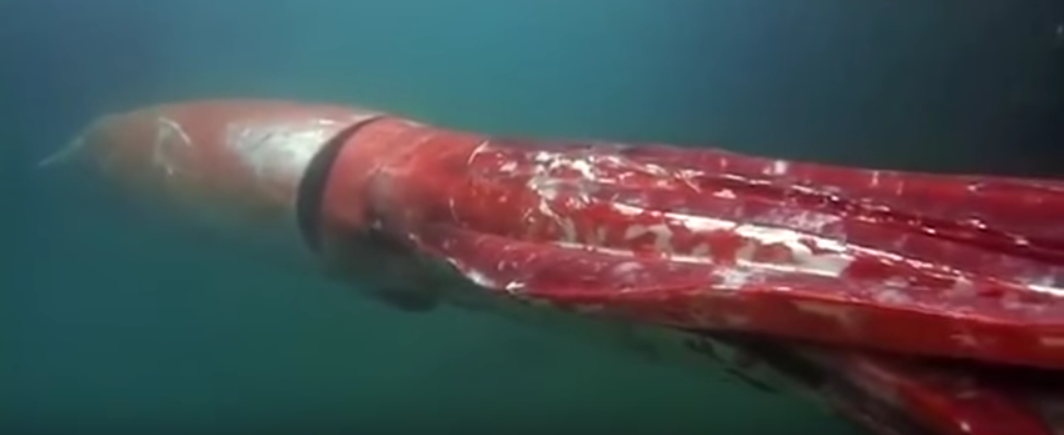
PZ beat me to the punch (I really think he should be penalized for the time zone difference). Japanese researchers, the same group that caught the photographs in 2004, have filmed a live giant squid. The research team, led by Tsunemi Kubodera, videotaped the giant squid at the surface as they captured it, on squid bait, off the Ogasawara Islands south of Tokyo, earlier this month. The squid was a female juvenile of about 24ft which falls shy of the 60ft record.
CNN video is here.
Video from Reuters (best and no plugins required)