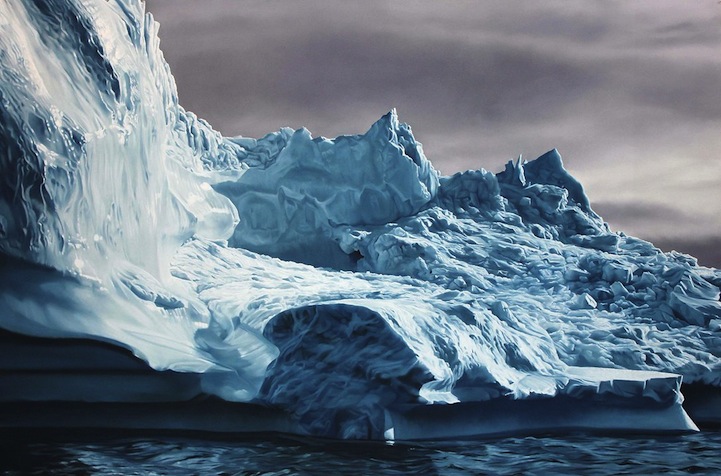
Is Antarctica Melting?
Comments (2) | Date Posted: January 17, 2010 at 8:11 PM
What do you think of when see the term “seawater”? Salty water? Perhaps fish-poo-covered-bacterial-ooze-slime-haven-so-salty-I-puke-in-my-snorkel-every-time-it-touches-my-tongue? Well, the definition of seawater has been limited by how we can measure it and what type of information that we wish to glean from knowing something about seawater.
For over 30 years now, researchers have defined seawater based solely upon its salinity. The problem is that salinity is measured by conductivity and this measurement assumes that the entire world’s oceans have the same salinity. It is well-known now that this is not true. For instance, deep sea water is more dense because it is colder and concentrated with more salt. In fact, this slight difference between deep sea water and surface water explains different behaviors of each body of water. Oceanographers can actually track the movement of water in ocean by mapping the changes in salinity over time for a body of water.
Over the course of the last few years. Dr. Frank Millero and colleague have created a new definition of seawater that takes into account the many advances in ocean thermodynamics over the last 30 years. If you are interested in the details of the new equations and more of the history you can check out this freely downloadable report (link opens a pdf) from the Australian environmental agency CSIRO. The interesting parts are summarized in this press release from CSIRO:
Salinity, comprising the salts washed from rocks, is measured using the conductivity of seawater – a technique which assumes that the composition of salt in seawater is the same in all the world’s oceans.
“The new approach, involving Absolute Salinity, takes into account the changes in the composition of seasalt between different ocean basins which, while small, are a factor of about 10 larger than the accuracy with which scientists can measure salinity at sea,” Dr McDougall says.
Until the new description of seawater is widely adopted, ocean models will continue to assume that the heat content of seawater is proportional to a particular temperature variable called “potential temperature”.
“The new description allows scientists to calculate the errors involved by using this approximation while also presenting a much more accurate measure of the heat content of seawater, namely Conservative Temperature,” Dr McDougall says.
“The difference is mostly less than 1ºC at the sea surface, but it is important to correct for these biases in ocean models.”
This will be an important correction for climate change change models. Even though we here at DSN think the deep sea is the most important habitat on the planet, much of the economical parts of the ocean (i.e. fishing industries, coral reef tourism, etc.) lie in surface waters which are more sensitive to smaller fluctuations in temperature. By taking into account heat capacity and potential temperature, climate change models will be better tweaked and will reflect a more accurate model of ocean processes into the larger picture.
Hat tip to Wild Shores of Singapore.
The House passed legislation on Friday intended to address global warming and transform the way the nation produces and uses energy. The vote was the first time either house of Congress had approved a bill meant to curb the heat-trapping gases scientists have linked to climate change. The legislation, which passed despite deep divisions among Democrats, could lead to profound changes in many sectors of the economy, including electric power generation, agriculture, manufacturing and construction. The bill’s passage, by 219 to 212, with 44 Democrats voting against it, also established a marker for the United States when international negotiations on a new climate change treaty begin later this year.
A step of the right direction, but many conservation organizations feel the legistation falls well short of what where we need to be and well behind the EU. I also find it disheartening that admist the general public support and unequivocal evidence for global warming that the vote was 219-212.
BERLIN (AFP) — Indian and German scientists have said that a controversial experiment has “dampened hopes” that dumping hundreds of tonnes of dissolved iron in the Southern Ocean can lessen global warming. The experiment involved “fertilising” a 300-square-kilometre (115-sqare-mile) area of ocean inside the core of an eddy — an immense rotating column of water — with six tonnes of dissolved iron.
As expected, this stimulated growth of tiny planktonic algae or phytoplankton, which it was hoped would take out of the atmosphere carbon dioxide, the principal greenhouse gas blamed for climate change, and absorb it. However, the scientists from India’s National Institute of Oceanography (NIO) and Germany’s Alfred Wegener Institute (AWI) did not count on these phytoplankton being eaten by tiny crustacean zooplankton.
“The cooperative project Lohafex has yielded new insights on how ocean ecosystems function,” an AWI statement published on Monday said.
“But it has dampened hopes on the potential of the Southern Ocean to sequester significant amounts of carbon dioxide (CO2) and thus mitigate global warming.”
“Flow velocities of ocean-ending outlet glaciers would have to be about 49 km/yr, 70 times faster than those glaciers move today” for Greenland to raise sea level 2 m, says Tad Pfeffer about his new research in Science. That’s three times faster than he and his colleagues have ever observed an outlet glacier to move. This doesn’t mean sea level isn’t rising due to glacier melt. Actually, the oceans could rise more and faster than International Panel on Climate Change (IPCC) scientists believed possible.
Image from Free Geography Tools
There is a nice write-up on the latest and greatest thought-exercise on global warming and sea level rise (SLR) at Scientific American online, complete with links to stunning pictures of glacier flows. The basic premise of the story is that Greenland, the world’s largest island, holds enough ice to raise global sea levels by 7 meters. That’s enough to sink parts of Manhattan. Try it yourself. But the thrust of the research is that Greenland’s ice melt won’t sink Manhattan because the glaciers are moving too slowly for a global SLR of more than 2 little ol’ meters. Low range scenarios predict SLR < 1 m by year 2100, including thermal expansion.
Global warming denialists may claim that the results of the study downplay the effects of sea level rise, but they do not. One to two meters is a significant rise for low-lying coastal communities. Furthermore, the new estimate is higher than the high-end IPCC estimate of 0.16- 0.60 m SLR by 2100. Coastal communities, beware of this state of denial. Seawalls will not help you. They’ll just drain your municipal budget. Focus instead on outbound highways and bridges.
Now, I am no expert on global warming. I am skeptical of Doomsday scenarios (the world was supposed end 25 years ago). But, I study oceanography, listen to my professors, and choose to defer to experts when possible. Now that so many climate scientists agree that Earth is warming and the ice is melting, the pressing question for coastal communities like mine becomes not “if or if not” but “how, when, and where” will sea level rise?
Lifeguards in the Mediterranean have a new problem, and they have overfishing, pollution, and global warming to thank for it. Stinging jellyfish invaded beaches off Barcelona a few weeks ago injuring 300 people and sending 11 to the hospital, reports the New York Times. Now patrol boats skim the water with nets and lifeguards post red and yellow flags to warn of approaching swarms.
These jellyfish near shore are a message the sea is sending [to] us saying, ‘Look how badly you are treating me’
- Dr. Josep-Maria Gili, a jellyfish expert from the Institute of Marine Sciences of the Spanish National Research Council in Barcelona.
This is ripe for a new TV show set on Mediterranean beaches. Call it Jell-Watch. Cue the trailer. “In a world, where .. lifeguards battle overfishing and global warming”. Who knows? It could be a hit. Maybe revive the Pam Anderson franchise. And David Hasselhoff is huge in Europe. It’s gotta fly.

Spring is in the air. Spring Break is upon us, and the mind begins to wander… to the poles? Well, yes, because the Antarctic is calving enormous glaciers and researchers are predicting a seasonally ice-free Arctic by the year 2030. Break out the kayaks and suncreen. It’s “Wild on, Nuuk.”
The news wire is full of stories about the rapid melting of the Wilkins Ice Shelf 1000 miles south of South America. If the warming trend continues, the folks on the Patagonian coast of Argentina will be watching icebergs float off their coast just like the Kiwis in the video below. Check it out. Can Argentina “tango on the ice floe” like New Zealand does? I dunno. We’ll see…
J. Stroeve and colleagues at the National Snow and Ice Data Center at University of Colorado, Boulder report that the Arctic lost ice cover roughly equivalent to an area the size of Texas and California combined in 2007. Only half the ice cover remains from the glory days in the 1950’s and 1970’s.