Get the DSN Logo!

Awards

Research Blogging Awards 2010 Finalist

Categories

Tag Cloud

Every Whale Has Its Bone

This one goes out to David from my lab who just got back from 2 months down under in Antarctica and deployed whale bones for part of his experiments. You can read up on all his updates while he was at sea.
Every Whale Has A Bone (with apologies to Brett Michael)
We both sink silently still in . . . → Read More: Every Whale Has Its Bone

  • Delicious
  • Digg
  • Fark
  • Facebook
  • FriendFeed
  • Netvibes Share
  • NewsVine
  • Reddit
  • Slashdot
  • StumbleUpon
  • Google Bookmarks
  • Yahoo Bookmarks
  • Share/Bookmark

Dispatches from Antarctica – Farewell Weddell Sea

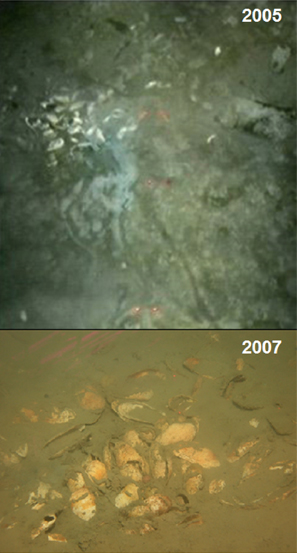
Living vesicomyid clams 100 kilometers from the former edge of the Larsen B Ice Shelf as initially seen in 2005 (top), and images of what may be the same clam bed now dead in 2007.  Although the image quality is poor, the trails in the 2005 image are characteristic of those made by living vesicomyids.  Upper image is from Domack et al. EOS Transactions, American Geophysical Union 86, 269-276 (2005).  Lower image is from Niemann et al. (2009)

David Honig is a graduate student in marine science at Duke University in the lab of Dr. Cindy Van Dover. He is participating in LARISSA, a 2 month multinational expedition to study the causes and consequences of the ice shelf collapse. He will be posting regular updates on the expedition exclusively for Deep . . . → Read More: Dispatches from Antarctica – Farewell Weddell Sea

  • Delicious
  • Digg
  • Fark
  • Facebook
  • FriendFeed
  • Netvibes Share
  • NewsVine
  • Reddit
  • Slashdot
  • StumbleUpon
  • Google Bookmarks
  • Yahoo Bookmarks
  • Share/Bookmark

Dispatches from Antarctica – Sampling the Inverted Benthos

David Honig is a graduate student in marine science at Duke University in the lab of Dr. Cindy Van Dover. He is participating in LARISSA, a 2 month multinational expedition to study the causes and consequences of the ice shelf collapse. He will be posting regular updates on the expedition exclusively for Deep Sea News readers!
——————————
6 . . . → Read More: Dispatches from Antarctica – Sampling the Inverted Benthos

  • Delicious
  • Digg
  • Fark
  • Facebook
  • FriendFeed
  • Netvibes Share
  • NewsVine
  • Reddit
  • Slashdot
  • StumbleUpon
  • Google Bookmarks
  • Yahoo Bookmarks
  • Share/Bookmark

Dispatches from Antarctica – First Month’s Progress

David Honig is a graduate student in marine science at Duke University in the lab of Dr. Cindy Van Dover. He is participating in LARISSA, a 2 month multinational expedition to study the causes and consequences of the ice shelf collapse. He will be posting regular updates on the expedition exclusively for Deep Sea News readers!

——————————

2 February 2010

One month into LARISSA, one month to go: a summary of progress and an outline of remaining cruise objectives

Completed (green) and remaining (red) work on the 2010 LARISSA field campaign. Unless ice conditions improve, we may not reach many of our sampling sites.

It has been one month since the “LARsen Ice Shelf System, Antarctica” (LARISSA) science team left port in Punta Arenas, Chile bound for the rapidly-disappearing Larsen Ice Shelf System. Our main target was the embayment formerly occupied by the Larsen B Ice Shelf—a 75-story-tall floating slab of ice the size of Rhode Island that disintegrated over the course of just four weeks in 2002—and the even larger Larsen C Ice Shelf immediately to the south that may be nearing a catastrophic, Larsen-B-style collapse. LARISSA plans to use the Larsen B and C Ice Shelves as a model system for understanding why Antarctic ice shelves collapse, how often they collapse, and what effect such rapid disintegration has on underlying marine communities.

Unfortunately, it is now February and we have yet to reach the Larsen B embayment. The Weddell Sea was choked with rotten fast ice in January and the Palmer could not push far enough south to reach the Larsen B. “Fast ice” forms on the sea surface (as opposed to ice shelves which form on land as glaciers) and can be anywhere from a few inches to tens of feet thick. “Rotten” fast ice contains pockets of slush. The RVIB in RVIB Nathaniel B. Palmer stands for “research vessel ice breaker,” but the ship is designed to break through hard fast ice that cracks into rigid fragments the ship can easily push aside into piles. Trying to break rotten fast ice is like pushing aside toothpaste—progress is slow and pressure the ice exerts against the hull can reach dangerously high levels.

Instead of fighting a perilous and futile battle against miles of rotten fast ice, we moved into fjords west of the Antarctic Peninsula. From there, we reasoned we could use the two helicopters on board to install monitoring equipment on the glaciers that flow into the Larsen B and C embayments. Meanwhile, our ship-bound scientists could extract sediment, invertebrates, and other data from the fjords relevant to LARISSA objectives. After nearly three weeks west of the Antarctic Peninsula, we have now returned to the Weddell Sea for a final assault on the Larsen B. It is a good time to review our progress thus far. What have we accomplished? What remains to be done?

Work thus far has contributed to several key LARISSA objectives:

Continue reading Dispatches from Antarctica – First Month’s Progress

  • Delicious
  • Digg
  • Fark
  • Facebook
  • FriendFeed
  • Netvibes Share
  • NewsVine
  • Reddit
  • Slashdot
  • StumbleUpon
  • Google Bookmarks
  • Yahoo Bookmarks
  • Share/Bookmark

Dispatches from Antarctica – Rothera

David Honig is a graduate student in marine science at Duke University in the lab of Dr. Cindy Van Dover. He is participating in LARISSA, a 2 month multinational expedition to study the causes and consequences of the ice shelf collapse. He will be posting regular updates on the expedition exclusively for Deep Sea News readers!
——————————
26 . . . → Read More: Dispatches from Antarctica – Rothera

  • Delicious
  • Digg
  • Fark
  • Facebook
  • FriendFeed
  • Netvibes Share
  • NewsVine
  • Reddit
  • Slashdot
  • StumbleUpon
  • Google Bookmarks
  • Yahoo Bookmarks
  • Share/Bookmark

Dispatches from Antarctica – Coring Sludge

David Honig is a graduate student in marine science at Duke University in the lab of Dr. Cindy Van Dover. He is participating in LARISSA, a 2 month multinational expedition to study the causes and consequences of the ice shelf collapse. He will be posting regular updates on the expedition exclusively for Deep Sea News readers!
——————————
24 . . . → Read More: Dispatches from Antarctica – Coring Sludge

  • Delicious
  • Digg
  • Fark
  • Facebook
  • FriendFeed
  • Netvibes Share
  • NewsVine
  • Reddit
  • Slashdot
  • StumbleUpon
  • Google Bookmarks
  • Yahoo Bookmarks
  • Share/Bookmark

Dispatches from Antarctica – Barilari Bay

David Honig is a graduate student in marine science at Duke University in the lab of Dr. Cindy Van Dover. He is participating in LARISSA, a 2 month multinational expedition to study the causes and consequences of the ice shelf collapse. He will be posting regular updates on the expedition exclusively for Deep Sea News readers!
——————————
22 . . . → Read More: Dispatches from Antarctica – Barilari Bay

  • Delicious
  • Digg
  • Fark
  • Facebook
  • FriendFeed
  • Netvibes Share
  • NewsVine
  • Reddit
  • Slashdot
  • StumbleUpon
  • Google Bookmarks
  • Yahoo Bookmarks
  • Share/Bookmark

Dispatches from Antarctica – Everything is Big in Andvord Bay

David Honig is a graduate student in marine science at Duke University in the lab of Dr. Cindy Van Dover. He is participating in LARISSA, a 2 month multinational expedition to study the causes and consequences of the ice shelf collapse. He will be posting regular updates on the expedition exclusively for Deep Sea News readers!
——————————
19 . . . → Read More: Dispatches from Antarctica – Everything is Big in Andvord Bay

  • Delicious
  • Digg
  • Fark
  • Facebook
  • FriendFeed
  • Netvibes Share
  • NewsVine
  • Reddit
  • Slashdot
  • StumbleUpon
  • Google Bookmarks
  • Yahoo Bookmarks
  • Share/Bookmark

Dispatches from Antarctica – Opportunistic Sampling

David Honig is a graduate student in marine science at Duke University in the lab of Dr. Cindy Van Dover. He is participating in LARISSA, a 2 month multinational expedition to study the causes and consequences of the ice shelf collapse. He will be posting regular updates on the expedition exclusively for Deep Sea News readers!
——————————
16 . . . → Read More: Dispatches from Antarctica – Opportunistic Sampling

  • Delicious
  • Digg
  • Fark
  • Facebook
  • FriendFeed
  • Netvibes Share
  • NewsVine
  • Reddit
  • Slashdot
  • StumbleUpon
  • Google Bookmarks
  • Yahoo Bookmarks
  • Share/Bookmark

Dispatches from Antarctica – Slow Days

David Honig is a graduate student in marine science at Duke University in the lab of Dr. Cindy Van Dover. He is participating in LARISSA, a 2 month multinational expedition to study the causes and consequences of the ice shelf collapse. He will be posting regular updates on the expedition exclusively for Deep Sea News readers!
——————————
14 . . . → Read More: Dispatches from Antarctica – Slow Days

  • Delicious
  • Digg
  • Fark
  • Facebook
  • FriendFeed
  • Netvibes Share
  • NewsVine
  • Reddit
  • Slashdot
  • StumbleUpon
  • Google Bookmarks
  • Yahoo Bookmarks
  • Share/Bookmark