ScienceOnlineOceans
ScienceOnlineOceans avatar


Will Smith – Miami by GuenZou
Mark it on you calendars October 11-13th IT WILL BE OWN in Miami.  Interested in the intersection of the ocean ecosystem and the digital online landscape?  Then you need to attend!!

A great team is assembled to pull this bad boy off including David Shiffman, aka Mr. Shark.  This man may care more about this conference than sharks and if that is only half true then this is going to be THE conference to attend.

This conference is already shaping into being something spectacular.  The  conference is in an unconference format that allows participants to set the agenda.  Interested in seeing a specific topic at the meeting? Head over to the planning wiki and suggest something you want to lead or simply want to participate in.

We are really looking to draw in some new people into the same old community and to highlight innovative examples of combining the oceans and online spheres.  

Who can attend? Anyone! Any interested scientist, journalist, student, blogger, communicator, activist, or member of the public is welcome. Due to logistical limits, we will have to cap total attendance at 200, including organizers, presenters, and attendees.

If you thought the the Deep-Sea News Suite Party at ScienceOnline is legend imagine what it going to be at whole conference of marine online folks!

You can keep up with the new by following @ScioOceans on Twitter, the hashtag #ScioOceans, the planning wiki, or the Facebook page.

scioOceans_poster

The Ocean Cleanup. The newest of the new plans to remove marine plastic.
The Ocean Cleanup. The newest of the new plans to remove marine plastic. avatar

I’m just going to come out and say it, any project that touts itself as the “World’s first realistic Ocean Clean-up Concept” is just asking to be torn apart.

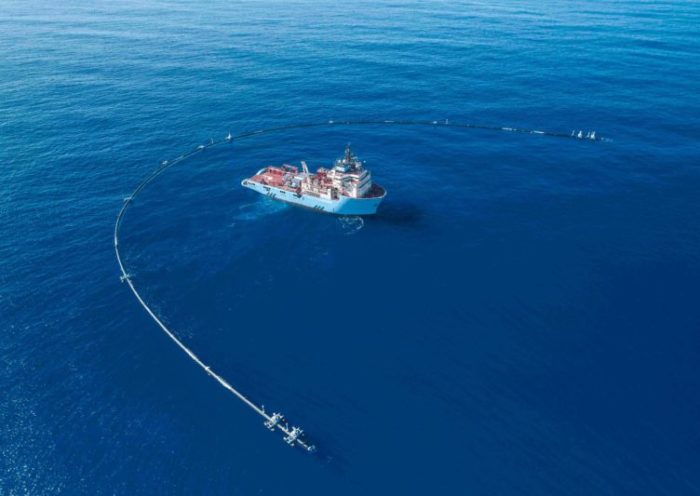
“The Ocean Cleanup” is the brainchild of a 19-year old Boyan Slat. He proposes using the oceans themselves to clean up plastic. By setting up a line of giant sifting booms across the major ocean gyres, ocean currents will push plastic into these giant traps to be collected and reused for profit.  He plans to set up an array of 24 of these sifters and calculates they will clean the ocean in 5 years.

The Ocean Cleanup’s proposed plastic sifting boom.

Before I add my two cents, here’s what Miriam had to say about the idea at the Marine Debris Listserv:

Dear all,

I’ve tried to stop fact-checking to every cleanup scheme, but I guess it’s an addiction at this point. Also, I feel that as a community we cannot move forward with practical solutions to marine debris until we lay some of these common misconceptions to rest. These points respond Boyan Slat’s TEDx talk, but you can also see photos of his proposal here: http://www.boyanslat.com/plastic5/ and http://www.boyanslat.com/in-depth/.

  • Most zooplankton don’t survive being caught in a standard manta net, never mind being spun in a centrifuge. They might still be twitching, but they have lost a lot of their important parts, like antennae and feeding apparatus. When we want to capture live zooplankton, we use special live-collection nets and are very, very careful. For gelatinous zooplankton like salps, the only way to bring them up in good condition is to individually capture them in glass jars on SCUBA. I am highly skeptical that any significant proportion of zooplankton are viable after caught in a net and spun at 50 RPM. (though I realize that he’s not proposing to do this on a large scale.) 
  • Mooring fixed “ships” in the open ocean (avg depth 4000 meters) is highly improbable for a lot of reasons. Just to pick one: I could not find data on the absolute deepest mooring in the world, but this implies that it is approximately 2,000 meters. http://www.offshore-technology.com/projects/atlantisplatform/. So these ships would have to be moored at twice the depth of one of the deepest moorings that existed ~2007. 
  • Having seen no data, I can’t really speak to the efficacy of floating booms in removing microplastic. However, Giora Proskurowski & colleagues have shown that microplastic get mixed down below the surface in fairly moderate winds. These booms would be unlikely to function in any significant wind and wave action. And the mixed layer in the open ocean can get quite deep, around 100-150 meters in the winter with storms. 
  • Speaking of wind and wave actions, ships on fixed moorings and thousands of miles of booms (because the scale of this is also improbable) have the potential to create a lot more marine debris, and seem particularly hazardous to entanglement-prone marine life. 
  • This isn’t even getting into issues of scale (the California Current alone is ~300 miles across), maintenance and fouling…

I realize that Mr. Slat is a student, and have no doubt that he, and the inventors of countless other plastic cleanup schemes, have only the best of intentions. I am hoping we can work together as marine debris professionals to channel their energies into more productive directions.

Regards,

Miriam Goldstein

While I can’t speak to what these booms will and will not pick up, I completely agree with her I am highly skeptical whether the design is even feasible from an ocean engineering standpoint. Here are some of the major unanswered technical questions:

1) How does the sifter work?  To be honest, I am not completely sure. The website and TED talk are completely devoid of technical details. But from what I can gather from the concept art and the talk, I think the booms have large nets underneath them that gather plastic into what I think is a oversized swimming pool leaf trap shaped like a manta ray. UPDATE: I misinterpreted the images on the website. The design as it stands now has no nets, only the initial tests had nets. Now I have to ask, what is that sheet hanging down from the booms?

2) The booms.  The claim is that only 24 sifters are need to clean the ocean and span the gyre radius, which means the booms have to be huge. Possibly 100′s of kilometer wide. Are they rigid or flexible? Are they the manta rays? How will they be kept in formation?

3) Anchoring something that large.  I am going to assume that the booms need to stay relatively taut to retain their shape and the most obvious way to do this will be with multiple anchor lines. The water depths are deep (>3000 m), horizontal surface motions needs to be small and then there is all that water pushing on what is essentially a giant paddle. That means a fairly sophisticated plan for anchoring the array will have to be developed. Having seen how large anchors are for low-tension subsurface moorings (>1000 kg), I can’t even begin to imagine what they are going to use or how that is going to be set up.

4) Biofouling. I forsee two major biofouling issues. The first is biological growth, which can be particularly bad because all the major mechanical parts are near the surface. There is going to be growth on the mesh, on the booms, on everything submerged which can make the booms and nets heavy, dragging them underwater. The second is fishbite. Did you know that fish attack underwater moorings like crazed rabid zombie munchers?  Now I don’t know if fish would actually chew on the mesh, but previous experience indicates they are not picky about what pieces of underwater line they snack on. So what will happen if fish gnaw holes through the collection nets?

5) The assumption of low current speeds. This is a bad assumption. While the array may not be placed in the most energetic current regime, storms and eddies can briefly induce large currents which could place a lot of stress and shear on such a large array.

6) Zero bycatch by net avoidance .  Sorry, I couldn’t resist.

Swim free zooplankton!

The Ocean Cleanup project is still in the planning stage, so all these problems have the potential to be solved. But I think it is highly unlikely that an array of this size and magnitude will ever be feasible.

UPDATE: Another good roundup by Micheal Cote of potential issues with the Ocean Cleanup design can be found here. http://climateadaptation.tumblr.com/post/46515698066/this-invention-keeps-popping-up-in-my-daily

UPDATE 2:  Some more critiques brought to my attention in the comments

http://kumu.cc/2013/03/27/those-crazy-plastic-cleaning-machines/

http://inhabitat.com/the-fallacy-of-cleaning-the-gyres-of-plastic-with-a-floating-ocean-cleanup-array/


Ways for marine scientists to save money and beat the budget sequester
Ways for marine scientists to save money and beat the budget sequester avatar

David Aldridge is a phytoplankton-loving marine biology PhD student at the National Oceanography Centre in Southampton, UK. Also the founder and editor of Words in mOcean, a website dedicated to publishing blog posts and features on marine science.  We’ve asked David to guest post for us here at DSN.  Enjoy!

Title picture

So, Republicans and Democrats entered into a giant game of chicken with the US’s finances and now science funding will be slashed faster than Usain Bolt sprinting down an airport walkway. It is a good thing that marine science is cheap to carry out, with very little infrastructure, equipment, publication and travel costs. Oh wait, that’s not right, is it. We’re all screwed… or are we? Follow these money saving tips (most of which involve some sort of human rights violation against grad students) and you may just make it through unscathed: 

One man research vessels

In the UK, it appears that we have already started using swimmers fitted with sensors for collecting oceanographic data. In the future, many of the best oceanographers will clearly be super-fit ‘one man research vessels’. You need to get ahead of the game, start going to your local swimming pool before and after work, and train your ass off! What’s that you say? “I’m a senior professor and I can’t even climb a flight of stairs without breaking into a deluge of sweat, how am I supposed to swim thousands of miles?” I have one word for you: Grad students. Just remember to test their swimming capabilities on interview day — or better yet, only interview candidates who have Olympic medals in long distance swimming events. For large, cumbersome lab equipment, you may also want to invest in a raft of undergraduates (pictured below supporting a flow cytometer).

Picture1

On the left, a one man research vessel; on the right, a raft of undergraduates

Picture2

Artists impression of what your homemade CTD may look like

CTD rosette on a budget

The cost of a full sized CTD is about $500,000 and has to be shared with a whole group of other annoying scientists (and if American TV has taught me anything, it is this: sharing = communism). A good dive computer will monitor temperature and depth whilst only setting you back a couple hundred dollars. Tape this to a salinity probe (a few hundred dollars) and a bunch of used soda cans, and you have saved yourself over $499,000. This thing will also be far more lightweight than a real CTD — ­ something your grad student will appreciate as they haul it across the ocean on their back.

ROV for almost free

Take one brave (and preferably pressure resistant) volunteer (grad student), equip with a (very) waterproof camera, attach ball and chain to ankle, and wait for the photographs of the deep-sea to come flooding in. Retrieval of the ‘volunteer’ may be somewhat problematic, but try not to let them know that. To make sure that their sacrifice isn’t for nothing, attach the camera to a long piece of string in order to allow recovery of the photos. Failing this, we will all just have to wait for James Cameron to donate a deep-sea submersible to our department… I wouldn’t hold your breath though. (You may suffer the same fate as your grad student!).


‘Open access’ publication

Picture 3

You spent years writing and editing a paper and sent it to a journal, who will now sell it back to your fellow academics for a small fortune. Unless of course you stump up some hard cash yourself and make it open access. Hardly fair is it? You do all the hard work, and then some (unpaid) intern does 3 hours of ‘formatting’, and the publishing company that he works for makes a killing!

What to do then? You could try to publish a whole journal article on your blog, but you would probably end up infringing on some sort of copyright (of your own damn work!). But why not make your work open access by publishing it 140 characters at a time on Twitter… your followers will love you for this! (Who doesn’t love having their Twitter feed being taken up by a single person?).

Picture4

Travel to conferences

Isn’t it obvious? Travel on the back of your ‘one man research vessel’, or float there at your leisure on your ‘raft of undergraduates’.


DSN community, I need your help
DSN community, I need your help avatar

I’m going to shameless co-opt the DSN soapbox for selfish research purposes for a moment.

Do you know anyone who lives near Seadrift TX, east of Corpus Christi/West of Houston?  I have a satellite tag that came ashore in Espiritu Santo Bay, inside Matagorda Is. and I’d love to get it back.  It was on a female whale shark called Lucy, who was tagged near Isla Contoy, Mexico.  The tag came off in the Flower Garden Banks offshore from Texas and gradually drifted inshore.  I’m pretty sure its on the beach now.

Last ping was 28.333N 96.598W, or the green arrow in this map.

map

It’s likely lying on the beach of that tiny spit of land, which is called Long Island.  There’s a boat ramp close by at the end of Lane Rd. that comes off Adams St (Rt. 185), which connects Seadrift to Pt. O’Connor.  Any help much appreciated, please share with your Texas friends and colleagues.  People can contact me through this website.

And THANKS!

The tag looks like this

The tag looks like this

Don’t try to learn marine taxonomy from SpongeBob SquarePants
Don’t try to learn marine taxonomy from SpongeBob SquarePants avatar

At some point someone had sent me this video as a joke – according the SpongeBob SquarePants, this is what nematodes do in the deep sea:

Video embedding was disabled by YouTube, so click here to watch the video.

(And if you’re really lazy, here is a screenshot):

Nematodes according to SpongeBob – AVERT YOUR EYES!!

I was so utterly horrified at this depiction that I had to rant about it publicly. Everything they’re trying to say about nematodes is WRONG!!! In case you tried to absorb some anatomical facts about nematodes from that clip, please erase them from your memory, take a cold shower, and consider the following (scientifically correct) points:

  • Nematodes have a mouth at the TOP of their head. Not the side.
  • What are those lines going across their body? Are the SpongeBob animators trying to suggest nematodes are SEGMENTED worms??? The mere thought is so preposterous that I’ll give the animators the benefit of the doubt. Perhaps they were trying to imply that these nematodes are from a pseudo-segmented group of nematodes, such as the genus Desmoscolex, which has rings (known as desmen) around its body. These desmen form via nematode secretions and famously collect all sorts of gunk from the environment.

The nematode species Desmoscolex frigidus (image courtesy EOL)

  • If you have a clean nematode (not carrying any organic gunk on the side of its body, which some do) it will look mostly transparent under the microscope, not that awful shade of vomit green.
  • Nemtaodes are POINTY at BOTH ends of their body. Pointy!

Even C. elegans is pointy at both ends (image courtesy of EOL)

  • Nematodes move in what is called “sinusoidal motion” – they wriggle their body side to side forming the shape of the letter “S”. They do not bounce up and down and they certainly do not have sound effects accompanying their movement.
  • Nematodes DO NOT EAT WOOD. Shipworms (not actually worms but a type of clam) are the ones famous for eating wood. Nematodes eat pretty much everything else BUT wood, including diatoms, bacteria, protists, plants, and yes even other nematodes.
  • Last time I checked, nematodes were not eusocial animals.

So thanks, SpongeBob animators, for ruining an opportunity to teach your audience about nematode taxonomy and ecology. This scientist is not impressed.

That is all. Carry on.

23 Species Giant Squid or Just 1
23 Species Giant Squid or Just 1 avatar

urlAs I mentioned before, in 1857 Japetus Steenstrup, a Danish biologist scientifically named several squids and octopods in the shortly titled Hectoctyldannelsen hos Octopodslaegterne Argonauta og Tremoctopus, oplyst ved Iagttagelse af lignende Dannelser hos Blacksprutterne i Almindelighed. Among those species Steenstrup named was the Giant Squid or Architeuthis dux. The scientific name comes from the Latin archi- or Greek arkhi- meaning chief or most important, the Greek word teuthis for squid; and the Latin dux meaning leader.  So literally the name Architeuthis dux translates to “most important squid leader”.  That is scientifically an awesome name.

Since 1857, everyone wanted to name a new giant squid species. And who wouldn’t because they are awesome? Thus to date 20 species of giant squid are named.  But quite frankly not everyone buys into this gaggle of giant squid.   Nesis in the 1980’s suggested that only three valid species exist, Architeuthis dux in the North Atlantic Ocean,Architeuthis martensi in the North Pacific, and Arciteuthis sanctipauli in the Southern Ocean. Of course, no one knows for sure.  The key would be in the genes.

Because Ed Yong is magical and important and knows about Giant Squid papers before I do, he beat me to the punch on reporting about the new Giant Squid genetic paper.

Now, a team of scientists from eight countries, led by Inger Winkelmannfrom the University of Copenhagen, has tried to settle the debate by looking at the kraken’s genes. Together, they amassed tissue samples from 43 giant squids caught all over the animal’s range, from Florida to South Africa to New Zealand. They sequenced each sample to piece together its mitochondrial genome—a small secondary set of DNA, which sits outside the main genome in tiny bean-shaped batteries.

The team found that the giant squid’s genetic diversity is incredibly low. Even though the individuals hailed from opposite corners of the world, they differed at less than 1 in every 100 DNA letters. For comparison, that’s 44 times less diverse than the Humboldt squid, which only lives in the eastern Pacific. In fact, the giant squid seems to be genetically narrower than any other sea-going species that scientists have tested, with the sole exception of the basking shark.

So instead of 21 there is 1.

As I mentioned in am email to the Great and Magical Yong

First this is the research project I dreamed of conducting.  Secondly the results are even more interesting than I would have imagined.  The finding of just one species is not unexpected and finally provides the missing molecular evidence so sorely missing.  What is amazing is the total lack of genetic structure among ocean basins. I know of few animals that have the long range dispersal ability or behavior to ensure genetic exchange over such great distances.  More interestingly is that the genetic variation is even astonishingly low.

Why so low? Well there a multiple theories but one contender is that the population of Giant Squids was very low at some point the past.  This caused much of the genetic variation to be lost and thus Giant Squids slipped through a genetic bottle neck of sorts. Of course mitochondrial genome can be known to give odd results.  In this paper on polar bears, mitochondrial DNA gives a radically different conclusion than using DNA from the nucleus of the cell. (h/t to @joe_pickrell to pointing this argument and paper out)

But all that aside

I find it amazing that the largest invertebrate may also be a contender for the largest geographic range of a species.  Not even land can stop the giant squid. It is clear that there is much that remains a enigma about these ocean giants including the evolutionary history and biology that could achieve such a feat.

Winkelmann, Campos, Strugnell, Cherel, Smith, Kubodera, Allcock, Kampmann, Schroeder, Guerra, Norman, Finn, Ingrao, Clarke & Gilbert. 2013. Mitochondrial genome diversity and population structure of the giant squid Architeuthis: genetics sheds new light on one of the most enigmatic marine species. Proc Roy Soc B http://dx.doi.org/10.1098/rspb.2013.0273

The Earth’s Largest Ecosystem – in Your Back Pocket
The Earth’s Largest Ecosystem – in Your Back Pocket avatar

IMG_0065

Contributed by Nick Higgs, Adrian Glover & Tammy Horton

Today sees the launch of Deep Sea ID, a free app that allows offline access to the World Register of Deep-Sea Species and currently stores on your device the taxonomic information for over 20,000 deep-sea species, over 350 high-resolution photographs of deep-sea specimens as well as links to online taxonomic tools, sources and important references.

A lot of deep-sea biology (and marine science in general) uses video and image data, usually obtained through ROVs, HOVs and other camera systems. The data is often logged in real time and it is amazing to see an annotation pro or sagely professor in action, with their encyclopaedic knowledge of deep-sea taxa, calling out names as they flash up on the monitors.

Not everyone is gifted with such powers of memory recall. I work mostly with invertebrates, so when I see a big backboned animal winding it’s way past the camera, I am sorry to say it often gets logged as “fish”. I don’t have the knowledge to reliably say any more than that. I may well know the common name, but what about the Latin? Even if I do have an inkling of the family, what are the chances that I can spell it? If there’s an expert on board they can usually help but what if there isn’t? I’m sure that we’ve all been in similar situations.

The new Deep Sea ID app aims to help people like me and other scientists at sea or in the lab. It brings the awesome wealth of information held on the World Register of Marine Species database together with high quality images into a handy deep-sea guide. It isn’t a taxonomic key and you probably won’t be able to identify an organism down to species, but it can point you in the direction of the best resources for doing that job, with our ID Resources field on the taxon pages.

It is also a powerful outreach tool that I trialled last week at the UK’s largest science fair for kids. I was able to walk around and share a slide-show of deep-sea animals and microbes at the touch of a button (the little camera icon at the bottom of the screen) and the response was fantastic. Give it a try!

Deep Sea ID is a tool developed by deep-sea scientists for the deep-sea community. We are very grateful to all of the scientists and photographers who contributed images, data and expert knowledge. This is just the first step and we would welcome your corrections and contributions of images for future updates. Please get in touch via the World Register of Deep-Sea Species, where you can also learn more about how we constructed the database and where data the data came from.

* The app has been developed as part of the INDEEP Working Group 1 on Taxonomy and Evolution, with financial support from INDEEP.

Where’s the cream filling?
Where’s the cream filling? avatar

That’s pretty much the first question I ask myself when starting any sea beastie dissection. Sadly, I have yet to encounter a cream-filled critter, but I guess this is what happens when you shut down Hostess. Yep. I’m still bitter.

It leads to a most-intriguing second question though…If not cream filling, what IS inside the creatures of the deep?!?

Luckily, we need look no further than the new “Sea Monsters Revealed” exhibit located at Tampa’s Museum of Science and Industry.

Whale shark cream filling. Source: MOSI (with permission)

Whale shark cream filling.
Source: MOSI (with permission)

Sea Monsters Revealed uses the revolutionary polymer preservation technique commonly known as plastination to bring real sea animals onto dry land for an up-close and personal look at the most mysterious creatures the deep sea has to offer. Visitors will not only see the outside, but also the inside of the most elusive aquatic life ever discovered, including a 6-foot-wide manta ray, a 15-foot-long mako shark, a giant squid, and an 18-foot-long, 3,000 pound whale shark. All specimens in the exhibition are authentic, stunning examples of the mysteries that lie beyond our shores and have been carefully recovered in accordance with the highest animal protection standards. -MOSI

Crabs Source: MOSI (with permission)

Crabs
Source: MOSI (with permission)

They had me at manta ray insides…but if that’s not enough to do it for you, the exhibit contains 18 full specimens, over 150 smaller critters and other important beastie bits and pieces. Essentially it’s the aquatic equivalent to the world-renowned “Bodies” exhibit, but in my opinion…way cooler.

The traveling display, created by John Zaller and his crew, takes visitors not just through a salty anatomy lesson, but on an entire oceanic experience where they can “walk” on the seafloor, travel the depths of the sea in a specialized submersible, “meet” explorers and renowned ocean advocates Fabian Cousteau and Sylvia Earle, and explore “Earth’s last great frontier.”

Besides the obvious, why else is this exhibit amazing? It’s all in the subliminal messaging…

Sea Monsters Revealed explorers will re-emerge from the depths of the exhibit with a greater understanding of the world’s oceans and our relationship to them as humans. Additionally, they will learn that the health of the oceans and preservation of these beautiful species is within our control through conservation initiatives around the globe. Guests will be given the opportunity to participate in these initiatives through follow-up conversations with programs such as the NOAA Marine Sanctuaries Program. -MOSI

As a budding scientist and ocean enthusiast myself, I only hope that this exhibit will serve to educate and spark public curiosity like nothing other than a 3,000 pound whale shark can.

I know I am curious.

Sea Monsters Revealed will be on display till September 2, 2013, when I hope it makes its way over to my neck of the woods. For all the juicy, cream-filled details on tickets and such, visit mosi.org.

Source: MOSI (with permission)

Source: MOSI (with permission)


The lack of the Irish!
The lack of the Irish! avatar

I love St Paddy’s Day.  I’m Scots-Irish-Australian, so I never drink (baddum-tish!), but I do like bangers and mash and all things gaelic.  In pondering how to celebrate on DSN, I considered a post of green fish, but that was just too easy.  Instead, I thought I’d present some fish with Irish patronyms.  So off I went to Irish Central to get a list of the top ten Irish last names, and thence to trusty Fishbase to sift through the expected avalanche of species named after Irish folks. Cos, like, Irish people are everywhere right?  They’ve spread across the globe like cultural dandelions, so presumably there’s lots of them in taxonomic circles, or at least prominent enough to get species named after them.  Cue wheels falling off…

Cirrhilabrus walshi

Out of the top ten Irish last names, which, if you’re interested, are Murphy, Kelly, O’Sullivan, Walsh, O’Brien, Byrne, Ryan, O’Connor, O’Neill and O’Reilly, I found just EIGHT species out of 28,000-ish in the Fishbase record, and that includes synonyms no longer in use.  Only two Irish names had more than one entry: Walsh, with the pretty Cirrhilabrus walshi and stunning (wah-wah!) electric ray Torpedo walshii (a synonym for T. nobiliana); and O’Connor, which had three cyprinids and a Galaxias.  That last one is of some coincidence.  Galaxias oconnori is a synonym for G. olidus, which was a topic of part of my PhD thesis and is quite common around where I grew up, in the Australian suburb of – yep – O’Connor.  The suburb is named after a former high court judge who died in 1912 and the fish was named the same year, so its possible that they are the same O’Connor, but I can’t get a hold of the original paper quick enough to remain relevant so for now it’s a mystery.

Galaxias olidus (oconnori)

So why aren’t there more fish with Irish names?  I honestly can’t tell you, except to say that I am pretty sure that patronyms in no way reflect the typical frequencies with which different last names occur in the population (and population WHERE?, I might add).  Some names are severely over-represented, for sure.  Consider Agassiz; there are at least 83 agassizi‘s – ten times more than the top ten  Irish names put together.  Ya gotta hand it to old Louis, he certainly made a mark!

 Happy St Paddy’s Day and Sláinte to all!

A Pee Shanty
A Pee Shanty avatar

Source: Wikimedia Commons

Source: Wikimedia Commons

There is an ancient nautical proverb commonly passed down from generation to generation amongst members of the diving community. I do believe it goes a little something like this…

“There are those that pee in their wetsuits and there are those that lie about it.”

(I would actually even add a third category to this little diddy for people, like myself, who shamelessly enjoy peeing in their wetsuits. Don’t judge me.)

All embarrassing tendencies aside however, what is it about descending into the briny blue that consistently has one wishing they had hit the head before leaving the poop deck?

The fact of the bladder is this…that urge to visit the salty water-loo, a phenomenon known as immersion diuresis, stems from two rather inconvenient challenges that come with visiting the underwater world. Pressure and temperature.

Challenge #1: Under Pressure (Doo doo doo do do doo do)

Normally, your body is accustomed to atmospheric pressure at approximately 14.7 pounds per square inch (@sea level). However when you are diving, hydrostatic or water pressure is significantly greater, increases drastically with depth, and comes at you from all angles….yes she said it.

Even if you don’t scuba dive, if you have ever dove to the bottom of a decently sized pool you have most likely felt the effects of this pressure. That nagging need to “pop” or equalize your ears before reaching deeper depths comes from the pressure difference between your inner ear and the water pressing on your eardrum.

So what’s a body got to do to deal with the weight of the watery world on it’s shoulders?

Source: Designed2BeSweet

Source: Designed2BeSweet


Not only does this increased compression influence the air spaces in your body (i.e. your lungs, your ears, your sinuses, etc.), but it also interacts with your cardio vascular system. The hydrostatic pressure on your body reduces circulation in your extremities and since you have a relatively finite volume of blood at any one point in time, the greater part of your blood starts to collect in your core. This process is somewhat akin to that of those squishy toys with the eyes that pop out when you squeeze them. Except when water tries to squish you, all your inner juices simply go to the important part of your body. (Though it would be cool if your eyes popped out too…more cool for me, not so much for you.) Pressure, however, isn’t the only thing that causes this circulatory displacement.


Challenge #2: Ice Ice Baby (Doo doo doo do do doo do …oh the irony)

This past week, diving off the coast of San Diego, I hit a record personal low.

Bottom temperature: 50 °F

Just to put into perspective how I felt about this…(Warning: NSWF)

Beyond the explicatives that ensue from jumping into frigid water, numbing of the arms and legs is also a common occurrence. This loss of feeling is a result of your body trying to keep all your important bits and pieces warm by shunting blood from your outer limbs to your core in a process known as vasoconstriction.

1+2=Pee?

So what does all of this have to do with your underwater potty dance?! Well, whether by pressure or by temperature, both of these situations leave you rather full around the mid-region. All of the blood that has been

Vasopressin Source: Wikimedia Commons

Vasopressin
Source: Wikimedia Commons

translocated to your core is essentially psyching your body into thinking it has too much fluid. Normally, bodies don’t like anything out of the ordinary so they have regulatory mechanisms in place to compensate.

In this instance, the mechanism is known as the Henry-Gauer reflex after the two scientists who first described it. When the body’s blood volume is shifted into the core this puts pressure in these regions and in the atrium of the heart. Here, receptors are triggered by the resultant stretching of pressured areas.  A signal is then transmitted from the heart to the hypothalamus saying, “Warning…tank is full. Stop vasopressin production!” Vasopressin is a nifty little antidiuretic hormone (ADH) whose primary job is to retain water in the body. Once production of the hormone has come to a stand still…cue flood gates and warm golden happiness.

So next time when nature calls and you’re underwater…just own it…everyone does it.

With all your seals broken and minds blown, I leave you with this. In true DSN fashion, the shanty that inspired my inquiry into this subject. Much appreciation to the pee filled safety stops of Katie Sievers and Sarah Wheeler that lead to this lyrical composition.

 A Pee Shanty

Drink a bottle. Fill your bladder. 

Down the ladder and you’re ready to pee.

Plenty to pee. Plenty to pee.

Your personal heater under the sea.


References

Divers Alert Network. Immersion Diuresis (Urge to Urinate). http://diversalternetwork.org/medical/faq/Immersion_Diuresis_Urge_to_Urinate

Graveline, D.E. and M.M. Jackson. (1962) Diuresis associated with prolonged water immersion. J Appl Physiol 17: 519-524.

Knight, D.R. and S.M. Horvath. (1985) Urinary responses to cold temperature during water immersion. Am J Physiol Regul Integr Comp Physiol 248: R560-R566.

Pendergast, D.R. and C.E.G. Lundgren. (2009) The underwater environment: Cardiopulmonary, thermal, and energetic demands. J Appl Physiol 106: 276-283.