Loud Noise Makes Crabs Even More Crabby
Loud Noise Makes Crabs Even More Crabby avatar


Growing up in Arkansas, in the epicenter of Tornado Alley, a sound has coded on my psyche. When I hear this sound my breathing accelerates, adrenaline levels rise, and a tightness emerges in my gut. The sound of the sacred tornado siren (above), a cultural icon in the South and Midwest, will elicit a physiological response in men, women, and children alike. “Grab tha child’n Ethel! A tornader be right here on us.” In response to ship noise, crabs respond much the same way.

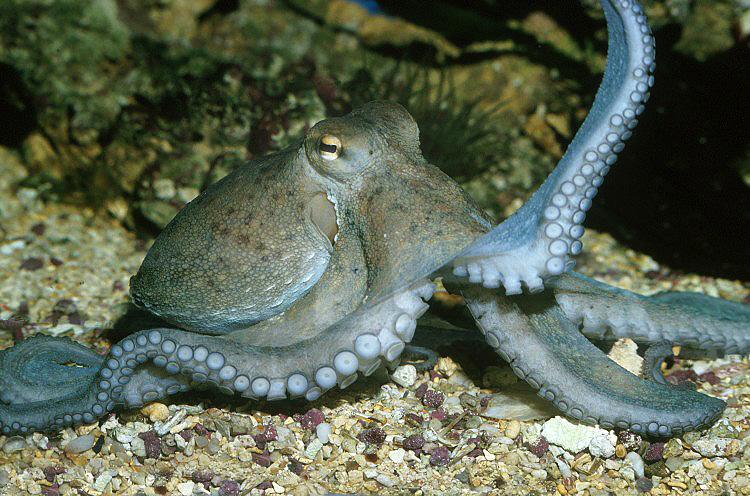
Carcinus maenas. Copulation 1

You kids turn down that damn noise

Ocean-AtlasNoises from humans like road and ship traffic, coastal development, sonar, pile driving, rowdy and drunk spring breakers have greatly altered the oceanic soundscape. These foreign noises can stress an animal as it prepares for action like fighting, hiding, or fleeing. After playing recorded ship sounds, the oxygen consumption of shore crabs (Carcinus maenAs) were greater than those experience just ambient noise. In other words the ship noise made the crabs a little more crabby. In some cases respiration was two times greater and on average was 67% higher. And fatter, ahem larger crabs, demonstrated a greater response than smaller crabs. Because larger crabs and animals in general respire more, larger crabs can also consume proportionally greater oxygen when stressed. Crabs repeatedly exposed to ship noise over two weeks eventually demonstrated less and less of stress response. One is that they simply no energy left to respond (I can only get excited once scenario) or simply acclimated to the sound when no threat presented itself (The boy who cried wolf scenario).

No word on what Enya or Barry White songs do to crabs. Although I can attest that when my next door dormmates in college played Led Zeppelin IV on repeat it did elicit a response from me.

Wale MA, Simpson SD, Radford AN. 2013 Size-dependent physiological responses of shore crabs to single and repeated playback of ship noise. Biol Lett 9: 20121194. http://dx.doi.org/10.1098/rsbl.2012.1194


NOW That’s What I Call Music! DSN Edition
NOW That’s What I Call Music! DSN Edition avatar

NOW DSN!

Put your tentacles up and raise the sea level. It’s finally here!

 Compiling the  Ocean’s Saltiest Hits, NOW That’s What I Call Music! DSN EDITION brings you 15 chart topping ocean science mash-ups.

From School House Rock to LMFAO, salt marshes to coral reefs, these biologists drop their science with a whole sea full of SWAG.

Check out our picks…Tell us your favorite… and get out there and make some more sweet beats. Who knows? Maybe they will make it into Volume 2…


1. “Save the Ocean” Artist: School House Rock!

2. “Overfishing” Artist: Neema Oshidary

3. “What Invert” Artist: Dr. Jeremy Long

4. “Bertness Lab Anthem” Artist: Nik Gonzales

5. “Under the Boat” Artists: Stacey Virtue, Katie Kozma, Alex Warneke

6. “Grazer” Artists: Pamela Reynolds, Paul Richardson, & the VIMS crew

7. “Me and My Shark Fin” Artist: Kool Kid Kreyola in collaboration with PangeaSeed

8. “Baby Got Reef” Artists: CKick and the Polyps

9. “Responser” Artist: Renee Dolecal

10. “Cruise, Cruise Baby” Artists: Coastal Ocean Observing Center

11. ”SciFund REMIX” Artist: Alex Warneke

12. “Sense That” Artist: Darren Fraser, Laura Williams, Laura Porturas, Stephanie Smith

13. “Chloroplasts” Artist: Levi Lewis

14. “Gaga Whale” Artist: Matt Siegle

15. “Get Your Reef On” Artist: Porites Massive


BONUS TRACK: “I’m a Climate Scientist” Artist: abchungrybeast

Climate Change and Hurricanes, Good for Squid?
Climate Change and Hurricanes, Good for Squid? avatar

humboldt-squid-washing-up-people_62649_600x450

NOTE PLEASE READ UPDATES AT END OF POST

Several news agencies are reporting today about an interesting phenomenon occurring in the Mississippi River.

The Memphis Flyer reports

In the last several years hurricanes have ravaged the Gulf coast causing millions of dollars of damage to property and the loss of numerous lives. More powerful hurricanes also destroyed millions of acres of marshes…Climate change is also greatly altering the saltiness of the ocean, what scientists refer to as salinity.

“The significant loss of marshes on the southern Louisiana coast and a less saline ocean has allowed for Gulf of Mexico water to migrate up the Mississippi River,” stated Dr. April Montgomery of the National Hurricane Center.  The increases in salinity of the Mississippi River are allowing several ocean animals to migrate up the river.

“Currently we have reports of marine species reaching as far up as Helena, Arkansas,” noted Dr. Seth O’Dod, a squid expert with Mississippi State University. A deep-sea squid, however, has lead the invasion with record numbers. “Loligo fakei, a species typically found typically in the deep Gulf of Mexico, is moving up the Mississippi in dense schools but dying when they reach the warmer waters south of Memphis,” stated O’Dod. Apparently, huge masses of dead squid are being found on the shores of the river.

Screen Shot 2013-04-01 at 9.31.18 AMI love this quote from Earl Jones in the Helena Independent Record.

“My family has been farming the shores of the river for 10 generations and I ain’t never seen anything like this. The stank is awful but we been collecting them and spreading them across the field as fertilizer. We should have a better crop of soybeans this year.”

 Lower Mississippi River map showing areas of unconfirmed sightings of L. fakei 

UPDATE: Happy April Fool’s Day

UPDATE2: No seriously this is a April Fool’s post.

Announcing the DSN Pinterest empire!
Announcing the DSN Pinterest empire! avatar

Be worried – us marine scientists are officially taking over the internet. I’m super excited to announce the launch of Deep Sea News on Pinterest.

We’re still working out the kinks…and trust us, these new things can get pretty kinky (#TWSS). Bear with us as we build up our visual smorgasbord, and be sure to check out our initial smattering of pinboards:

SNAIL!
SNAIL! avatar

Sure this is a terrestrial snail and this is a marine blog.  But c’mon I’m a malacologist and snails and dubstep are a natural pairing

I’m a grazer baby.
I’m a grazer baby. avatar

I was just thinking to myself the other day on how we needed more songs about the finer things in life like seagrass and amphipods. How did the scientific masterminds of the Zostera Marine Network (ZEN) know?!? Or maybe this is just what happens when you’ve been in the lab sorting epifauna samples too long.

Either way, thank-you to Dr. Emmett Duffy and his crew for their wonderful DJ mastermix of Beck’s “Loser.”


For more information on the greatest seagrass network in the seven seas. Check out the ZEN project website.

Hormesis: Why drinking in moderation might actually improve your game
Hormesis: Why drinking in moderation might actually improve your game avatar

Even though my first love will always be chemical ecology, I often find myself dabbling in the exotic realm of ecotoxicology. It’s kind of dangerous and sometimes sexy and I think that’s why I am drawn to it.

Paracelsus is his name. Toxicology is his game.  Source: WikimediaCommons

Paracelsus is his name.  Toxicology is his game.
Source: WikimediaCommons

For the most part, experiments in ecotox are fairly cut and dry. Expose organism A to increasing concentration of potentially harmful chemical B and determine at what dose you see a response. In this system, we often expect that with an increase in concentration we increase the likelihood of an adverse effect. This “dose makes the poison” ideology can be traced back to the original gangster of toxicology himself, Paracelsus.

The traditional dose-response model comes in one of two delicious flavors: The linear response and the threshold response (witness epic powerpoint graph making below). The linear response represents a direct relationship between a nasty chemical and a negative effect, most usually your test organisms floating upside down in the porcelain throne, though there can be other adverse outcomes associated with critter behavior. The threshold response on the other hand depicts an organism that can tolerate low doses of a chemical to a certain point and then ends up on the same stairway to heaven or highway to hell (take your pick) as the linear response organism. Either way, no good can come of this. However, such information on lethal doses is critical for chemical management purposes.

H-o

Recently however, whilst being stumped by my own data, a rather brilliant ecotox friend shed light on the elusive third model known as Hormesis. I know, I know… it sounds like parseltongue, but I checked with some of my peeps over at Hogwarts, rest assured. It’s not.

The hormesis concept puts a very different spin on the original models. Instead of the negative or neutral responses predicted by the linear and threshold examples, organisms undergoing hormesis have a positive response at low chemical concentration levels.

What does this mean exactly? Well, let’s put it in a different context we can all better relate to shall we?

Scenario: You walk into your favorite club/bar and you are ready to get down with your bad self. Looking at our graph, we will put the DSN poison of choice on the x-axis (subliminal advertising so maybe they will give us free stuff) and our favorite sleazy scientist on the y-axis to represent “amount of game” as our response variable. Experiment is a go.

Slide1

Drink one: You are doing good. Maybe even working up the courage to bust a move or two? Who knows the night is young.

Drink two: Oh man, you are living large and sitting pretty. You are here for the ladies and the dranks and ain’t no one going to stop you. You are at the peak of your game.

Drink three: This is where you become “that guy.” All game is slowly (or quickly) going out the window.

Drink four: Even Ke$ha would be embarrassed for the hot mess you have now turned into.

Drink five: If you are still conscious at this point. We should be friends. However, this is highly unlikely.

Note: Usually when your test organism keels over from alcohol poisoning, it’s safe to say the experiment is over.

This faux, but oddly realistic example provides a perfect depiction of hormesis. At low doses of a toxin, your performance is actually heightened until your alcohol just becomes too much to handle. Why does this happen? Though this response has been seen more and more frequently in many ecotox experiments, the mechanism is a bit more difficult to get at. Some speculate however, that this phenomenon stems from an organism being able to utilize certain chemicals to their benefit or that the chemicals are putting their systems into overdrive mode, thus eliciting a positive response till they can no longer handle the increasing toxic effects.

It’s like Kayne (or Daft Punk depending on your musical preference) always says, “That that that that don’t kill you…”


References:

Calabrese EJ, Baldwin LA (2003) Toxicology rethinks its central belief: Hormesis demands a reappraisal of the way risks are assessed. Nature 421: 691-692

Calabrese EJ, Baldwin LA (2003b) Hormesis: the dose–response revolution. Annu Rev Pharmacol Toxicol 43: 175–197


Is Marianas Trench A Lifeless Void?
Is Marianas Trench A Lifeless Void? avatar

When he made his historic solo dive into the Mariana Trench last month, James Cameron brought back images and descriptions of a “lunar like” marine landscape nearly devoid of life.-via National Geographic

Returning from humankind’s first solo dive to the deepest spot in the ocean, filmmaker James Cameron said he saw no obvious signs of life that might inspire creatures in his next “Avatar” movie but was awestruck by the “complete isolation.” –via Christian Science Monitor

The quotes above illustrate just two of the many mainstream media pieces that highlighted James Cameron’s comment of a lifeless landscape at the bottom of the Marianas Trench.  However, Cameron fell into a trap nearly 200 years old.

Edward Forbes is the whipping boy of deep-sea biology.  Forbes’s big mistake was concluding, in the mid-1800s, that marine life could not exist deeper than 550 meters, what he called the “azoic hypothesis.” Given the state of knowledge at the time, it seemed logical that no species could survive under the extremes of high pressure, lack of light, and cold temperatures characterizing the deepest ocean. Unsurprisingly, Forbes’s thinking spread quickly among the scientific community. The azoic hypothesis ultimately proved wrong or this blog would have a lot less fodder for writing and a different title.  How Forbes was wrong is the interesting part.

orbview2

A satellite image displaying the amount of Chlorophyll a, an indicator of phytoplankton. In the eastern Mediterranean you can see predominantly dark blue colors indicating little Chlorophyll a.

Forbes based is azoic hypothesis on sampling he did in the eastern Mediterranean Sea, an area that sees little phytoplankton production.  With less food at the ocean’s surface, less food will sink to the deep ocean floor resulting in little abyssal life.  Unsurprisingly, when Forbes pulled his trawled samples from the deep they were not brimming with a cornucopia of life.

Forbes also didn’t know that the low food arriving to the deep sea miniaturized animals.  In one of the earliest papers on the deep-sea fauna, Mosely (1880) noted, “Some animals appear to be dwarfed by deep-sea conditions.” Almost a century later, Hessler (1974) noted that “individuals of certain taxa are routinely so small that they are of meiofaunal size.” Thiel (1975) echoes these comments by noting the deep sea is a “small organism habitat.”

Sierra Exif JPEG

Busycon carica

Consider that the entire collection of deep-sea gastropods from the western North Atlantic collected under the WHOI’s Benthic Sampling Program (44 samples, 20,561 individuals) would fit completely inside a single Busycon carica, a typical-sized New England knobbed whelk.  Forbes nets with their big mesh size allowed most animals to pass right through.  Today of course we use finer mesh sizes on nets or cores so we don’t miss the diversity of small life.

I cannot help but wonder if Cameron fell into the same trap that Forbes did so long ago, an underappreciation of the complexity and uniqueness of deep-sea life.

Was he waiting for charismatic megafauna that never arrived and potentially never existed at the deepest point in the ocean?

Bob McDondald in a recent Op-Ed  stated,

… there is no substitute for good science. Big budgets and lots of publicity gather public attention – a stunt such as a solo dive to the deepest part of the ocean will get an explorer into the history books, just as a free fall from the edge of space did.  But these are often one-off events. The whole point of the exercise was to get there. Science, on the other hand, is a systematic, step-by-step process that explores carefully, building on past successes and putting new discoveries into the broader context of the scientific community. A robot sub being hauled out of the water may not look as dramatic as the scene of a hatch opening and the triumphant explorer emerging to a cheering crowd, but what the science actually reveals is the most dramatic of all

Of course, I would be remiss not to mention another point glossed over and even blatantly misrepresented in the media.  Cameron’s dive, while worthy of praise on many fronts, is a not the first exploration of the deepest part of the ocean.  Scientists, especially Japanese researchers, have been sampling the bottom of the trench extensively for a few decades with robots and landers.

As McDonald points out, and the labor of many expeditions and scientists has demonstrated, the Marianas Trench is actually full of life.  Although contrary to what McDonald claims new research didn’t reveal this fact but only supports what we’ve known for a while.

Marianas Trench is teeming with microbial life.  In 1997, a species of the common bacteria Pseudomonas was discovered from 11,000 meters deep. In 1998, Japanese researchers using the remotely operated vehicle Kaiko found evidence of two barophilic, pressure loving as you would expect from trench critters, bacteria.  Both bacteria species were from completely different groups.  In 2006, Japanese researchers hit a biological gold mine of microbes.  Actinobacteria, non-extermophilic bacteria, three major groups of extremophilic bacteria, fungi…O my! And o’ how the reports of new microbial species just keep coming, and coming, and coming, and coming, and coming, and coming in.  Indeed, microbial activity is shockingly high…even for those of us expecting it.

Forams from Marianas Trench

Forams from Marianas Trench

Naysayers will surely point out how bacteria somehow don’t count as real life.  They live everywhere. These people have some size threshold for life to count. I give you naysayers protists!  Foraminifera, amoeboid protists vital for nutrient cycling in the oceans, also exist at the greatest depths of the Marianas Trench.  Perhaps some will need something even larger…a metazoan.

H. gigas

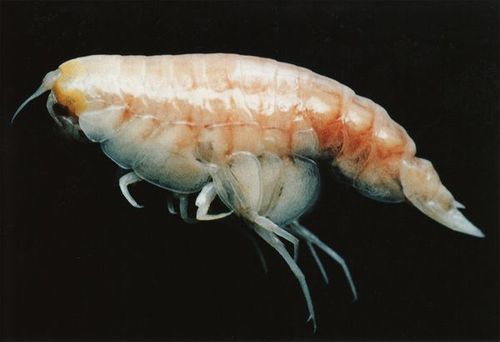
Hirondellea gigas

Multicellular life is also known from the Marianas Trench.  From even the earliest explorations the large crustacean, the amphipod Hirondellea gigas, was observed.  Scientists have even isolated bacteria from its body.  Indeed, larger organisms have been found at the bottom of several trenches (see photo below).  A specimen of sea anemone of the genus Galatheanthemum, a worm from the genus Macellicephaloides, an isopod crustacean of the genus Macrostylis, and a sea cucumber Myriotrochus bruuni are all known from the deepest trench on earth and reported back in the 1970’s by Torbin Wolff (of Haka fame).

1-s2.0-S0169534709002997-gr2

Cameron stated after his dive the necessity of returning to the deepest point in the ocean, the Challenger Deep, once again to explore.  I could not agree more. Our understanding of this trench, like much of the deep, is rudimentary.  We only have a partial glimpse of the life that existing there. However, we do know that it is not a lifeless void.  A wealth of life exists at Marianas Trench. You just have to know how to loo for it.

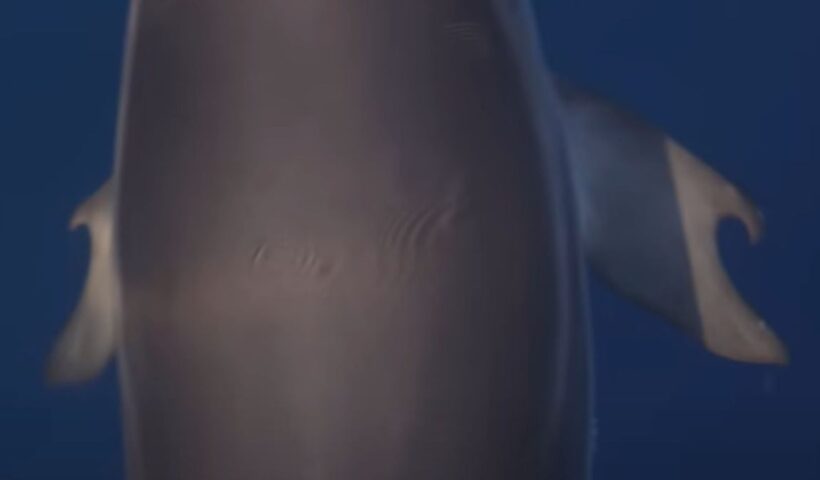
Dolphin Woo
Dolphin Woo avatar

Thanks to Cara Santa Maria for bringing this to my attention

Can’t stop laughing

This ice crack is whack.
This ice crack is whack. avatar

Kids, we all know that crack is bad for your body. And when it comes to sea ice, the same policy applies. Too much crack is whack.

Starting in mid-February a bunch of giant cracks in sea ice, or leads, began forming in the Beaufort Sea. Now a couple of leads are not unusual, but then they started spreading. A lot. You can check out the intense satellite imagery from NOAA below.

Typically, you will see leads of this magnitude in late spring, when sea ice is starting to melt and break up. Seeing this many leads this early in the season is unusual.  It is a little unclear what is happening from these movies, but it may be because a series of strong mid-winter storms may have caused the ice to weaken.  Regardless, this is fascinating stuff and is a great illustration of how the Arctic we see now is not like the Arctic we saw before.