Field Museum scientist Josh Drew recently brought to my attention a new and unusual paper describing a world first. The manuscript by Randy Honebrink and co-authors in Pacific Science describes the first documented attack on a living human by a cookiecutter shark, Isistius sp., and it’s quite an eye-opener. Cookiecutters are relatively tiny sharks . . . → Read More: The real cookie monster
This is a guest post that originally appeared as a Facebook conversation between the illustrious Drs. Jarrett Byrnes and Scott Richmond. Scott, Jarrett and I met in college theater and our conversations have only gotten more ridiculous since then. This one was so interesting that I asked to share it as a Deep Sea . . . → Read More: A scientist and a humanist walk into a bar; or On Myers-Briggs, Climate Science, and Knowledge
By Dr Bik, on  September 3rd, 2011 Ecology, Microbes, New Research, Organisms Bacteria, high-throughput sequencing, metagenomics, Microbes, pelagic, Seasonality, UK …because “High-throughput sequencing confers a deep view of seasonal community dynamics in pelagic marine environments”, however appropriate a title, seems far too dry and technical for a blog. I mean, I want people to read my posts, right? Don’t be fooled by the title, though: I am going to give you some seriously elegant science . . . → Read More: Big text files can tell you how the ocean works
By Archie Teuthis, on  August 30th, 2011 Conservation & Environment, New Research, Organisms Animal Kingdom, Catalogue of Life, Census of Marine Life, CoML, Ian Poiner, Mark Gibson, Organisms, Species Accumulation Curve, Species Discovery, Species Diversity, taxonomy, World Register of Marine Species, WORMS Mark Gibson is a divemaster, social scientist, and independent writer living in Washington, DC. He can be found blogging at Breaching the Blue. You can find Mark on twitter @breachingblue. The following post is cross-posted at his blog here. —————————————— How many marine species are there? It is a question that stumped even the . . . → Read More: New Innovative Estimate of Total Marine Species
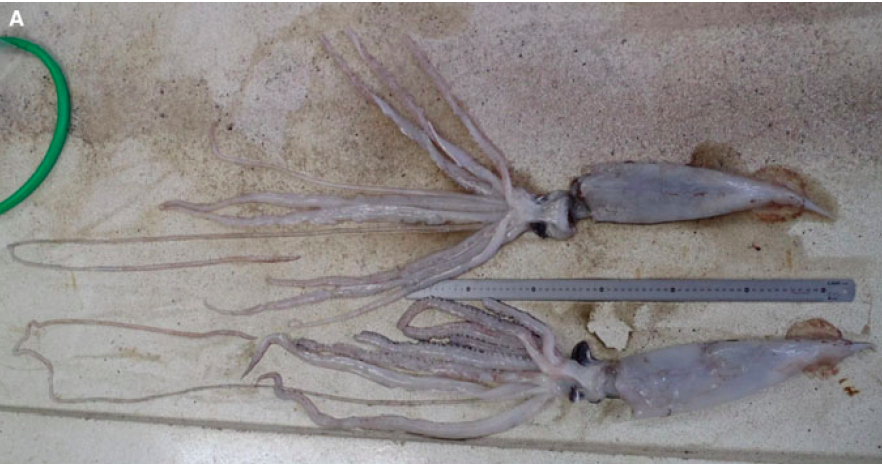
By Dr. M, on  August 17th, 2011 Adaptations, Biology, Cephalopods, Mating & Reproduction, New Research, Open Access competition, egg, oviduct, Reproduction, sex, sperm, squid All sperm are not the same. Among fruit flies the longer the reproductive tract of the female the longer the sperm. In tiny crustaceans called ostracods, sperm length can range from several hundred micrometers to several millimeters. And here is some trivia for your next cocktail party, sperm in ostracods can even be longer than . . . → Read More: There Is More Than One Way To Impregnate A Squid
Sometimes I think that those of us studying ‘minor phyla’ do so in order to prevent from developing some secret (potentially peverse) obsessions. Example: I recently attended the Society of Nematology’s 50th Anniversary meeting, where the plenary topic was….traumatic insemination. This was the subsequent topic of conversation for the next four days. “Write a blog . . . → Read More: A great day for a little Traumatic Insemination
We would be remiss at DSN if we didn’t blog about a paper that was brought to our recent attention. Warning the following material uses profanity with high frequency. Click the more button on your own risk. . . . → Read More: Expletive Infixation and Marine Scien-****in-tists
That’s right, you heard me—there are mushrooms that live in the sea. OK, well technically a mushroom is a fruiting body of a fungus with a cap, stem and gills, but lets take some dramatic liberties and run with it. A new draft manuscript recently necessitated that I review the literature on marine fungi – . . . → Read More: Marine Fungi are Totally Badass
By Dr. M, on  August 1st, 2011 Adaptations, Cephalopods, Coral, Ecology, New Research, Open Access, Organisms Anemone, Behavior, behaviour, Cephalopod, nervous system, personality, self-orgazing, Snail Personality is an unbroken series of successful gestures-F. Scott Fitzgerald Quirky, sheepish, fun-loving, lethargic, energetic, aloof, courageous, sensitive You might invoke these words to describe your friends and family. Indeed, you recognize them all by their distinctive personalities. You may even use these terms to describe your beloved dog or cat. But it is hard . . . → Read More: The many personalities of snails and anemones
From van der Meij and Reijnen (2011) Fig. 1 a–e The unsuccessful attempt of an edwardsiid sea anemone to feed on a Nembrotha lineolata. f A non-responsive Phyllidia ocellata caught by the tentacles of an edwardsiid sea anemone You may not realize that those unassuming slugs of the oceans, nudibranchs, are voracious predators in hiding. . . . → Read More: Anemones Fight Back Against Their Opressors
|
|
Recent Comments