
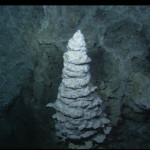
Your turkey isn’t the only thing that has beautiful plumage this Thanksgiving. So does the Arctic Ocean. Behold, the frost flower.

These spiky little bunches of ice form on thin and new ice in the Arctic Ocean. But these badboys can only form under very special conditions:
1) Calm winds. We can’t have these beauties blown away can we?
2) Cold, cold air. It has to be about 20C less than the water and since seawater freezes around -2C, that means the air must be about -22C or -7.6F. BRRR.
Frost flowers form when newly formed ice sublimates, that is ice changes directly from a solid to a gas totally bypassing the liquid stage. Initially, the water vapor formed by sublimation is the same temperature as the sea ice, but gets quickly cooled by the cold air. The air is then becomes supersaturated with water vapor, which means the air has too water much in it. Air really doesn’t want to hold all that excess water vapor, so when the supersaturated air touches another ice crystal the water vapor quickly turns back into ice. This process is called nucleation, on little chunks of ice that are sticking up out of the water or even ice crystals floating in air. Over time, more and more crystals form on existing ice. The crystals expand outward in spiky arms, creating the little punks we know as frost flowers. Frost flowers are found in the Arctic, the Antarctic and even grow on freshwater ponds.
But in the ocean, frost flowers have a really unusual characteristic. Unlike normal ice, which is extremely fresh, frost flowers are salty. The porous sea ice on which frost flowers form squeezes out salt water in a process known as brine rejection. Frost flowers wick up the salty brine onto the crystals, causing the salinity of frost flowers to reach 100 psu, nearly three times the salinity of sea water! Perfect for pickling.
I’ve never seen frost flowers in the wild. But you don’t have to go all the way to the poles to see beautiful ice. Just look in your freezer to find a close relative of frost flowers, hoar frost. You just might call it “freezer burn.”
*********************************************************************************************************
UPDATE: I’ve gotten a lot of questions about how large frost flowers really are. They are only about 3-4 cm or 1-1.5 inches across. Pretty tiny.
I’m not actually a frost flower researcher, I just found out they existed and wanted to share them with the world. To learn more about the effects of frost flowers there are great articles by those that study them and took those pics here http://schaechter.asmblog.org/schaechter/2011/05/frost-flowers-come-to-life.html and here http://students.washington.edu/bowmanjs/wordpress/?p=106
*********************************************************************************************************
UPDATE 2: Apparently I am not the only person that likes frost flowers. Several of the commenters there had more questions about frost flowers, which Jeff Bowman tackles here at his personal blog: http://students.washington.edu/bowmanjs/wordpress/?page_id=68

REFERENCES:




Awesome!
what a beautiful, wondrous world we live in!
this is awesome!!!!!!!!!!!!!!!
I have seen something similar to this, the crystals formed on downed branches. The dead wood was very wet and the air was dry and cold. My thought as to why it happened was the dead wood’s moisture content wanted to be in equilibrium with the surrounding air so as the moisture “escaped” it was frozen.
Now that I have read this article I realize that I missed a few steps in the process, just amazing….
wicked cool, thank you! never heard of frost flower before
“that is ice changes directly from a solid to a gas totally bypassing the liquid stage”
this is a pretty awesome effect, but I’m confused, wouldn’t it be from a gas to a solid, since its water vapor turning into ice? @_@
Just trying to sate my curiosity.
Prettiest thing ever!
Why does the newly formed ice sublimate only under these conditions? Why does it sublimate at all, rather than remain being ice?
Otherwise, so very beautiful…
today I learned something beautiful. thank you.
Seawater freezes at -2C? That’s news for me? The Baltic sea for example doesn’t freeze until -14C…
Skoksvalley, I saw that for the first time last year – it’s called ‘hair ice’ and you can read more about it here: http://my.ilstu.edu/~jrcarter/ice/diurnal/wood/
Can’t get a feel for the scale in the photo. Are they each a couple of inches across?
Very nice photography,
interesting article.
;)
Yes, please give us a scale! Would like to know the size of these things.
You are correct the gas will change from gas to ice, but that occurs later. The water need to get into the air first via sublimation so that it can then refreeze onto the ice forming frost flowers. Hope this helps!
LOL…I had to review thermodynamics to answer this one!
First, the conditions I listed apply to the formation of the frost flowers, not sublimation. The difference in the vapor pressure between the ice and the atmosphere is what causes sublimation to occur. I’m not going to go into the details of what vapor pressure is here, but you can think of vapor pressure as having properties similar to normal pressure. Like normal pressure, particles want to go from an area of high vapor pressure to low vapor pressure. Also, vapor pressure increases with increased temperature. Since the ice is warmer than the atmosphere, it has a a higher vapor pressure. The difference in this pressure causes the water particles from the ice to want to go to the atmosphere. Since the atmosphere is so cold, water molecules just change from a solid directly to a gas, thus SUBLIMATION!
Normally wind actually encourages sublimation as it whips the newly gaseous water vapor away from the surface. But when there is no wind, the water vapor can hang out near the ice, refreeze and cause the frost flowers.
Anyway hope this helps to clarify!
You might be thinking of the air temperature, because the coldest seawater temperature ever recorded is -2.6C. Generally, the colder the air is, the faster ice will form as water will lose heat faster.