
Editors Note: We are starting a new Scientist in Residence program at Deep-Sea News. The Scientist in Residence for each month at DSN would contribute substantial posts in the scientist’s area of expertise. We anticipate these will vary in topic from discussing new papers and commenting on recent events to revealing the specifics of doing their research.
For January, we chose Danny Richter from Scripps as our Scientist in Residence. Danny is a Ph.D. student studying diatoms and their role in global cycling of nutrients and carbon. As you can expect this has major climate change implications and as such he is active in attempting to influence national climate policy by lobbying government and giving public lectures. We are excited about Danny’s expertise gracing us in January. His writing is a welcome contribution to DSN. Make sure you welcome Danny below in the comments.
 In the days of my youth, a couple of friends and I decided it would be a good idea to dress up like pirates, go to the beach, and bury a treasure. In our case, that treasure consisted of a bag of peanuts and 5 pepsi’s. Hijinks ensued, and the result was a killer story, complete with pirate accent, that served as a convenient icebreaker in both college and grad school. Thanks to said story, I have enjoyed two full-fledged pirate-themed birthday parties, multiple pirate-themed presents, and possibly (though I think my beard deserves more credit), a wife.
In summary, I owe pirates. Accordingly, my answer to the question “Pirates or Ninjas” has always been a no-brainer: Pirates. Duh. Yet, the pirate story doesn’t get as much play as it used to, and not because I want to put some distance between me and my high-school self (well, maybe a little distance . . .). The problem, you see, is that pirates kill people.
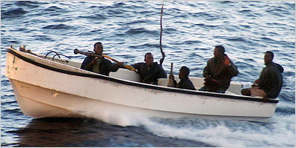
Around 2007 I started noticing news stories about actual pirates in the Indian Ocean. These pirates are not the swash-buckling, freedom-loving, rum-chugging pirates of Disney’s rendering. Rather, they are desperately poor, AK-47 toting unfortunates who, in addition to killing people, steal large quantities of stuff, hold hostages, and generally piss people off. Doubts about telling my pirate story crept in.
Later that year I went on an Oceanography cruise from India to the Seychelles. When we got on the boat, not only did they have a “scare pirate” (think scare crow, but with wooden gun instead of overalls), but pirate drills as well (we rush to a room complete with heavy sea-doors, lock ourselves in, and if you’re late and don’t know the password, you better hope you speak pirate). Early on in the cruise, we get an e-mail from the captain announcing that pirate attacks in the region were up 10% on the year before. No, they did not wear tricorn hats and have British accents, I was assured.

As oceanography is a profession that frequently brings me in contact with people who spend large portions of the year on ships crossing pirate-infested oceans, I am petrified that if someday I tell my pirate story, someone is going to say: “My friend Johnny was killed by a pirate you SOB!”, break an Erlenmeyer flask on the lab bench, and try to shank me. How much would that suck?
So, even though the fourth Pirates of the Caribbean is coming out in 2011 (and I will probably see it shortly after its release date), they no longer hold so warm and fuzzy a place in my heart. Courtesy of the Somali Pirates, I am officially conflicted, and it sucks.
To read more about real pirates, “Piracy at Sea” is an official topic at the NY times, and you can check it out here.




Excellent idea, Dr. M! Looking forward to the new series. And welcome, Danny!
I blame Robert Louis Stephenson. The kind of piracy he famously romanticized was a century old when he wrote about it, so already far enough in the past to gain a bit of patina. Perhaps people then spoke about great-grandfathers who had been a pirate, the way we now do about the ones who had been a horse thief. Stephenson gave them their iconic image, and aimed it straight at every boy’s heart.
Understandable Master Richter. Thus ends our pirate era, glad I got the story of the scurvy biscuit while it was still pipin hot. Shall we switch to ninjas? They don’t seem to be such an issue lately.
your shank by erlenmeyer flask moment had me laughing so hard!