
Twitter was all aflutter yesterday over a foul slandering of the sea slug Glaucus atlanticus. The culprit was an Australian article discussing these sea slugs washing up on Gold Coast beaches.
Ugly, blue, slimy, venomous, bluebottle-eating cannibals.
Those are just some of the words used to describe the strange sea creatures that have been turning up in their hundreds on the Gold Coast’s beaches with the north-easterly winds.
Not only was the article incomprehensible to those outside of the Gold Coast, but as Kate at Adventures of a Free Range Urban Primate said, “I find these one of the most beautiful of the nudibranchs.” So, along with Kate, let us refute this foul slander bit by bit.
Ugly: Glaucus is absolutely stunning while alive – iridescent blue and silver with gorgeous feathery tentacles. And you don’t have to go to Australia to see it – Glaucus is found throughout the open oceans of the world. However, it’s usually far from shore, feeding on pelagic jellies (more on that in a moment). Even if beauty is in the eye of the beholder, how could you turn down this gorgeous punim?
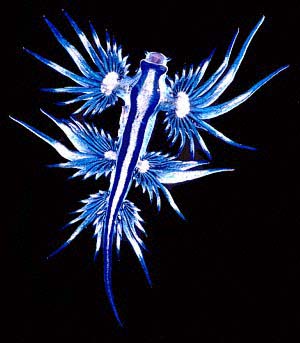
Blue: Well, yes. But WHY are they blue? The article suggested that it was camouflage, which certainly might be part of the reason. But the real reason might have to do with protection from ultaviolet light. Glaucus spends its life on the surface of the open ocean, drenched in strong sunlight. Its blue-violet pigments might help it to reflect those harmful UV rays – nothing sadder than a wrinkly, leathery sea slug. There are also blue copepods (sorry couldn’t find a photo), blue amphipods, and of course blue jellies. Together they form what Sir Alistair Hardy described many years ago as “The Blue Fleet.”
Slimy: Well, I suppose. If you want to judge a poor slug who wants only to protect its tender skin with some nice mucous.
Venomous: Glaucus is not truly venomous. Like many other sea slugs, they steal the stinging cells (nematocysts) of the jellies that they feed on, and incorporate them into their own bodies. This is an amazing feat – nematocysts are like spring-loaded spikes, and eating one without having it go off is something like ingesting a cocked mousetrap. Still, it’s probably best to avoid snuggling Glaucus, however tempted you might be. Which brings us to…
Blue-bottle eating: Glaucus around the world make their living nibbling at siphonophores – usually the abundant & widespread Velella, Porpita, and Physalia. (Physalia are what Americans call the Portuguese man-o-war and the Australians apparently call blue-bottles.) Siphonophores are essentially jellyfish cities – colonies of little polyps that specialize and work together to form a giant meta-organism. All of these species are common throughout the world’s temperate & subtropical waters, which is why Glaucus is also common. It lives amongst the jellies’ tentacles, nibbling away.
Cannibals: Well, sure, Glaucus might eat each other in a time of extreme deprivation. But usually it makes a living without even killing its prey – jellies can lose lots of tentacle bits without even noticing. Isn’t Glaucus sensitive? Charming? Adorable? Are you convinced?
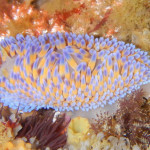
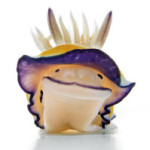
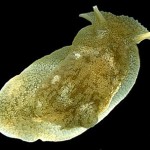
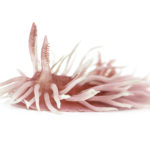
I am.
Besides, I consider Portugese Man O’ War eating to be a service to the world. The more creatures eating those things, the better!
Here is a blue copepod:
http://www.flickr.com/photos/artour_a/4076788171/
And you forget the most delicious blue swimmer!
http://www.dnr.sc.gov/marine/sertc/images/rollovers/blue%20Callinectes%20sapidus.jpg
Christie – I wish they actually ate them, but they just nibble about the edges. Sadly Glaucus does not lessen the OWIE in the water.
Michael – THANK YOU! And a lovely blue copepod it is! But I now have a strange urge to sprinkle it with Old Bay…
Wicked Slander
Little out of my league here..well way out actually, but this is so interesting. I won’t find them in my backyard pond, but hey if I did that would be very very cool, but I learned something..Now how do I work that into a conversation. “speaking of sea slugs’..Michelle
MY COS post..Autumn Meadowhawks Mating.
What a beauty! Thanks for helping set the story straight.