
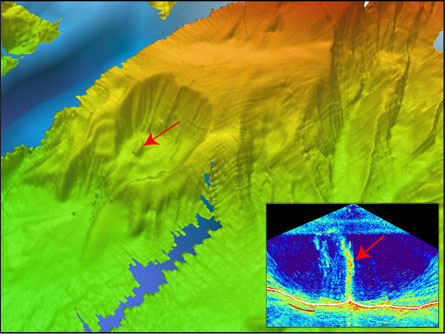
A recent oceanographic survey on the NOAA ship Okeanos Explorer led by James V. Gardner, a marine geologist at the University of New Hampshire, discovered a 1400 meter tall plume (4.3 Eiffel Towers) rising from the seafloor off California. The plume may have originated with a recent massive landslide that created the 3.6km “amphitheater-shaped” scar.
Water samples above the plume did not have high mineral contents, suggesting the feature is not a hydrothermal vent. Gardner reports his teams findings in Eos, a weekly newspaper from the American Geophysical Union for members (can someone send this to me?). The team thinks the plume is a methane gas bubbles coated in a veneer of methane hydrate ice, that quickly dissolve in warmer lower pressure water.
[googlemap lat=”39.7240885773337″ lng=”-125.35400390625″ width=”500px” height=”500px” zoom=”6″ type=”G_SATELLITE_MAP”]39.724089,-125.354004[/googlemap]
Related Posts
 Have you been watching Okeanos explorer? If not, this week is your chance!
 TGIF – Pretty pictures from Okeanos Explorer
 Okeanos Explorer in the Gulf of Mexico
 GUEST INTERVIEW: Peter Rona on the Diversity of Hydrothermal Systems on Slow Spreading Ocean Ridges
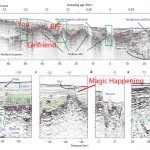 I Like Sills But Not A Fan Of The Popular Or My Friend’s Ex
Wildness!